
Driver Dies After Kanwariya Clash, FIR Seem to Be Reading From Different Scripts
The summary highlights the driver death following the reported assault and the conflicting accounts recorded in the FIRs, creating a strong focus on uncertainty and accountability. However, it does…
Politics
Indian Edition
By CMS Admin
🕵 AI Narrative Audit
The headline uses a critical, accountability focused framing by highlighting the driver death and conflicting FIR accounts, while leaving out the broader circumstances of the assault and the parties’ differing explanations.
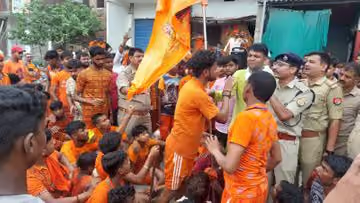
A 24 year old mini truck driver died in a New Delhi hospital days after he was allegedly assaulted by a group of Kanwariyas following a road incident in Uttar Pradesh, with police records presenting differing accounts of how the confrontation unfolded.
The victim, Mohd Azeem, a resident of Moradabad, was travelling towards Delhi for work on July 31 when his vehicle was involved in a collision with a group of Kanwariyas, according to the complaint filed by his father, Mohd Intezar. Azeem was subsequently taken to hospital for treatment and died on August 4.
The death has triggered questions over the circumstances surrounding the assault and the sequence of events that preceded it.
What the Familys FIR Says
According to the FIR registered on the basis of Azeem father complaint, Azeem was driving a mini truck from Moradabad towards Delhi when the vehicle collided with a group of Kanwariyas.
The complaint alleges that following the collision, members of the group stopped Azeem and assaulted him. The family has alleged that the beating left him seriously injured and that his condition subsequently deteriorated.
The allegations in the complaint form the basis of the investigation, but the precise role of each person involved has yet to be established by the police investigation or a court.
Another Account Emerges
The police records also contain a different version of the events surrounding the confrontation. Reports on the case indicate that the incident began as a traffic related dispute and escalated after the collision.
This has created an important distinction between the competing accounts: while the family complaint describes an assault on the driver following the collision, the other account places greater emphasis on the road confrontation and the circumstances leading up to the alleged attack.
Such differences in FIR and witness accounts do not by themselves establish which version is correct. Investigators will have to examine statements, medical records, CCTV footage and other available evidence before reaching conclusion.
Investigation Underway
The death has now transformed the case from an alleged assault into a matter involving a fatality. Police are expected to examine the events before, during and after the confrontation, including who was present at the scene and what happened immediately after Azeem was allegedly assaulted.
Medical evidence will also be significant in determining the nature of Azeem injurie and whether they were connected to the incident.
The investigation will ultimately have to establish whether the injuries sustained during the confrontation caused or contributed to his death and determine individual responsibility, if any.
A Case Where Evidence Matters
The conflicting accounts make the case particularly significant. The family's version and the alternate account cannot simply be treated as established fact until investigators verify them.
The incident also highlights the risk that can arise when traffic disputes involving large groups of religious pilgrims escalate into violence. During the Kanwar Yatra period, highways in northern India can experience heavy congestion, making road-safety and crowd management measures especially important.
For now, the central question remains what exactly happened after the collision on July 31 and who was responsible for the injuries that ultimately preceded Azeem death.
As the investigation progresses, evidence rather than competing claims will determine how the case moves forward.
Source: Editorial
View Original Source →