
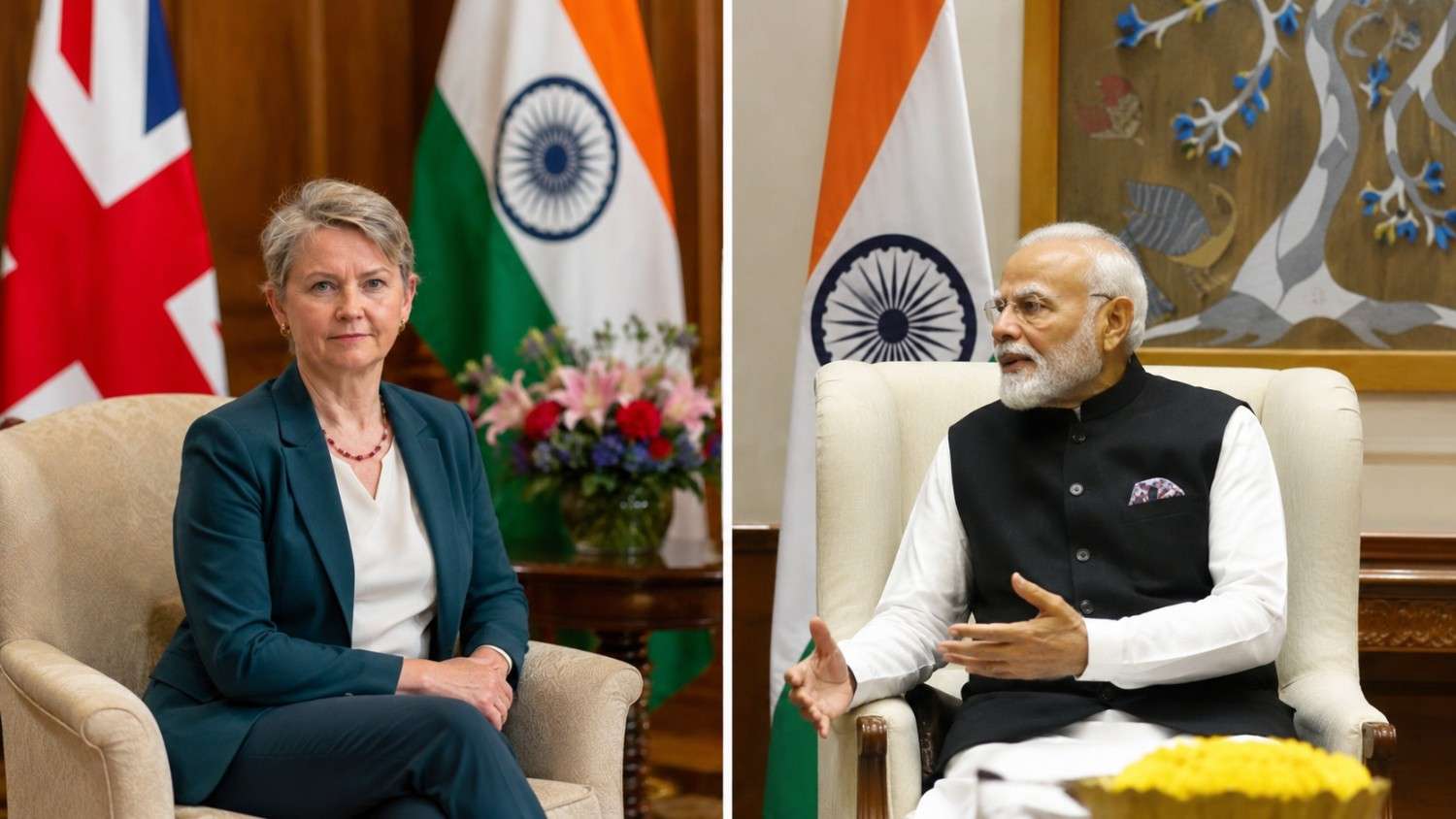
New Delhi: British Foreign Secretary Yvette Cooper will meet Prime Minister Narendra Modi and External Affairs Minister S. Jaishankar on Thursday as part of her first official visit to India. The visit comes amid growing geopolitical uncertainty and reflects both countries' efforts to strengthen cooperation on economic resilience, security, trade, and emerging technologies.
Cooper is scheduled to arrive in India late Wednesday after concluding a visit to China. During her stay, she will hold bilateral talks with Jaishankar before meeting Prime Minister Modi.
Focus on Global Stability and Economic Resilience
According to the British High Commission, Cooper and Jaishankar will discuss ways to deepen UK-India collaboration to reduce the economic impact of ongoing global conflicts, preserve international stability, and safeguard freedom of navigation.
The discussions take place against the backdrop of continued tensions in West Asia, which have affected global energy supplies and maritime security, prompting countries to strengthen international partnerships.
Building on the UK-India Free Trade Agreement
The visit follows Business and Trade Secretary Peter Kyle's recent trip to India aimed at advancing the implementation of the landmark UK-India Free Trade Agreement (FTA).
In a statement, the British High Commission said the Foreign Secretary's visit underscores India's importance as one of the UK's top strategic partners and seeks to accelerate cooperation across multiple sectors.
"The Foreign Secretary's trip sets an ambitious path for engagement with India, a top priority partner for the UK," the statement said.
Reviewing Progress Under Vision 2035
A major objective of the visit will be the annual review of the **UK-India Vision 2035**, the long-term roadmap guiding bilateral cooperation.
Cooper and Jaishankar will assess progress across key areas, including:
* Economic growth and investment * Technology and innovation * Defence and security cooperation * Climate action * Education and people-to-people ties
According to the British High Commission, the review aims to ensure that the partnership remains adaptable and responsive to evolving global challenges.
UK Emphasises India's Strategic Importance
British High Commissioner to India Lindy Cameron described the relationship as increasingly important in an uncertain global environment.
"The UK-India partnership is a bulwark against rising global uncertainty. Foreign Secretary Yvette Cooper's visit this week, her first visit in the role, is another important opportunity to build on that partnership."
She added that since the two Prime Ministers unveiled their shared vision for a modern UK-India partnership last year, the UK has prioritised expanding collaboration with India across strategic sectors.
### Key Areas Expected to Dominate Talks
The meetings are expected to focus on several strategic priorities:
* Strengthening bilateral trade and investment. * Accelerating implementation of the UK-India Free Trade Agreement. * Enhancing defence and maritime security cooperation. * Addressing global supply chain disruptions. * Expanding collaboration in artificial intelligence, innovation and clean technologies. * Deepening cooperation in education and research.
Looking Ahead
Cooper's visit highlights the growing strategic importance of UK-India relations as both countries navigate an increasingly complex global landscape. With discussions centred on trade, security, technology and regional stability, the visit is expected to reinforce long-term cooperation under the Vision 2035 framework while advancing shared economic and geopolitical interests.