
Wildfire Bring the Heat, Firefighters Bring the Overtime
The report focuses on how firefighters are coping with increasingly challenging wildfires, emphasizing the demands placed on emergency crews. It provides limited context on the causes of the fires,…
Politics
Berkshire Edition
By CMS Admin
🕵 AI Narrative Audit
The framing highlights firefighters resilience and the severity of wildfires while giving less attention to the broader causes, prevention measures, and long-term environmental impact.
Emergency services are facing growing pressure as several major wildfires have broken out across southern England during a period of exceptionally hot and dry weather.
The latest fires come after the UK recorded its driest July on record, with firefighters being called to large incidents across Hampshire, Berkshire, Oxfordshire and the Isle of Wight.
The combination of extreme weather, large rural fires and staffing pressures has raised concerns about how effectively fire and rescue services can respond when several major incidents happen at the same time.
New Forest fire leaves motorists abandoning vehicles
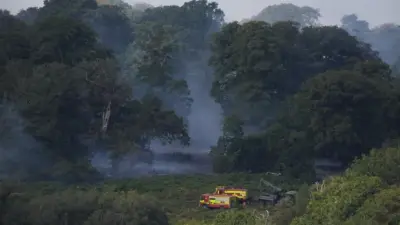
One of the most significant incidents occurred on Sunday when a fire spread from a van onto nearby heathland in the New Forest.
At its height, the blaze required the response of more than 120 firefighters and 26 fire engines.
The smoke could reportedly be seen from Portsmouth, around 30 miles (40km) away.
The incident came as Hampshire and Isle of Wight Fire and Rescue Service was also responding to fires at neighbouring properties near Southampton, placing additional demands on crews.
Some firefighters reportedly worked for more than 10 hours during the New Forest operation. The Fire Brigades Union said crews were supposed to be rotated after around five hours, highlighting concerns about the pressure being placed on firefighters during prolonged incidents.
Firefighter numbers have fallen
The challenges facing emergency services are not limited to the weather.
Mark Chapman, regional secretary for the South at the Fire Brigades Union, said the number of full-time firefighters had fallen substantially since 2010.
According to Chapman, around 12,000 full-time firefighter posts have been lost, leaving services attempting to deal with increasing demands with fewer personnel.
We're trying to do more with less, he said.
Recruitment of on-call firefighters has also proved difficult.
Many fire stations across Hampshire, the Isle of Wight, Oxfordshire and Dorset depend heavily on retained firefighters. These firefighters do not work for the service full time and frequently have other jobs, meaning their availability can vary.
Some stations unavailable for long periods
The staffing problem has also affected the availability of fire stations.
A Freedom of Information request made by BBC South found that one in five fire stations relying on retained crews in Hampshire and the Isle of Wight was unavailable for more than half of 2024.
For emergency services, prolonged periods of station unavailability can make it harder to maintain coverage when crews are already committed to major incidents.
The situation becomes particularly challenging during large rural fires, which can require firefighters and appliances to remain at the scene for hours.
Rural wildfires can affect response times
Chapman said major countryside fires could have consequences beyond the immediate area of the blaze.
When large numbers of firefighters and engines are sent to a rural wildfire, fewer resources may be immediately available to respond to incidents in nearby towns and cities.
This can potentially increase the time it takes for crews to reach other emergencies.
Government figures show that average fire service response times in England have increased by one minute and 18 seconds since 2010,11, reaching their highest level in the latest available data for 2025-26.
However, response times vary considerably between different parts of the country.
Factors including geography, population density, the availability of crews and fire engines, and the distance firefighters need to travel can all affect performance.
Hampshire response times under scrutiny
Hampshire and the Isle of Wight have experienced an upward trend in response times, with figures now at their highest level since 2010,11.
The service has also recorded the largest increase in response times among the seven fire services in the south of England.
However, Hampshire and Isle of Wight Fire and Rescue Service disputes some comparisons based on the government figures.
A spokesperson said its critical response time had remained stable at nine minutes and 49 seconds over the past two years.
The service explained that the government figures include incidents that it does not classify as critical incidents, accounting for the difference between the figures.
It also said it continued to perform better than other services operating in areas with comparable population density and levels of rurality.
Fire casualties in the area have also fallen, from 156 in 2010,11 to 85 in 2025,26, according to the service.
Climate change adding to wildfire risk
Staffing and funding pressures are occurring alongside a changing climate.
Research has indicated that rising temperatures and increasingly dry conditions associated with climate change can increase the likelihood of severe wildfires.
The Met Office has also indicated that 2026 is on course to become the UKs hottest summer on record, adding to concerns about the risk of further fires during prolonged periods of hot and dry weather.
For firefighters, this creates a difficult combination, larger and potentially more frequent fires occurring at a time when emergency services are already dealing with recruitment and resource challenges.
Government points to increased funding
The government has said it is ensuring fire and rescue services have the resources required to respond to emergencies and protect communities.
Funding available to most standalone fire and rescue authorities in England has increased by 4.7% compared with the previous year, with services receiving a share of a total £1.95bn allocation.
The Ministry of Housing, Communities and Local Government also said almost £1.95bn was being made available for fire services and that nearly £100m was being invested in upgrading national resilience.
The government argues that the investment will strengthen the country ability to respond to major emergencies.
Firefighters facing a growing challenge
The recent wildfires have highlighted how several pressures can collide during a period of extreme weather.
Fire crews must respond to increasingly demanding rural incidents while maintaining emergency coverage for towns and cities. At the same time, services are dealing with recruitment difficulties, staffing shortages, financial pressures and longer response times in some areas.
The Fire Brigades Union is calling for the recruitment of 5,000 additional full time firefighters across the UK, alongside increased central government funding.
For firefighters working on the ground, however, the immediate challenge remains putting out the next fire while ensuring crews have enough people, equipment and time to operate safely.
As hot and dry conditions continue, the pressure on emergency services could remain high making staffing, funding and preparedness increasingly important parts of the UK response to the growing wildfire threat.
Source: Editorial
View Original Source →