
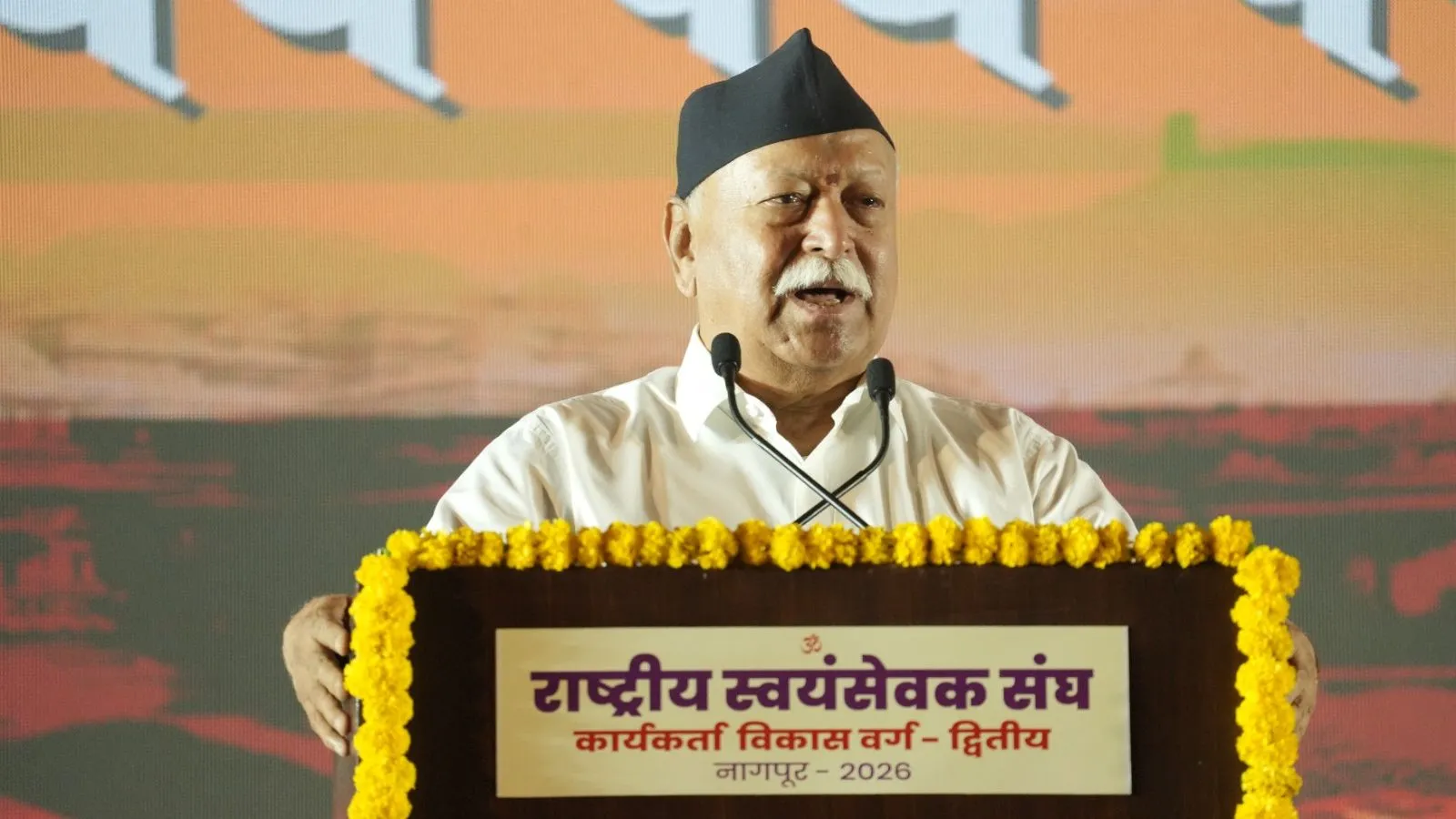
Nagpur: RSS Chief Mohan Bhagwat and industrialist Kumar Mangalam Birla on Thursday emphasized the need for India to strengthen its economic resilience, technological capabilities, and national preparedness amid rising global uncertainties. Addressing the valedictory function of a Rashtriya Swayamsevak Sangh (RSS) training programme in Nagpur, both leaders said India stands at a pivotal moment but must build stronger institutions and capabilities to fully realize its long-term ambitions.
Bhagwat remarked that although many view this as "India's era," the country is not yet prepared to assume the role of a "Vishwaguru" (global teacher) because significant groundwork remains incomplete.
Bhagwat: India's Time Has Come, But Preparation Is Incomplete
Speaking at the event, Mohan Bhagwat said the international community increasingly looks toward India for leadership and a new development model. However, he stressed that aspiration alone would not be sufficient.
"The world says that it needs a new path, and only India can show that path. India's time has come. But that is not enough. We have to be prepared for that time," Bhagwat said.
He noted that India has long spoken about becoming a Vishwaguru, but achieving that vision requires greater readiness across multiple sectors.
"We have been saying for a long time that India has to become Vishwaguru. So what is stopping us? Our preparation—it is still incomplete," he added.
Bhagwat also emphasized that India should pursue prosperity and global influence while remaining rooted in its civilisational values and cultural identity.
Kumar Mangalam Birla Highlights Global Economic Challenges
Aditya Birla Group Chairman Kumar Mangalam Birla, the chief guest at the event, focused on the rapidly changing global economic environment.
He said the world is currently facing multiple disruptions, including:
Geopolitical conflicts. Rising crude oil prices. Supply chain disruptions. Rapid advancements in Artificial Intelligence (AI).
According to Birla, these developments are reshaping the global economy at an unprecedented pace.
"Even though these are challenging times, this is India's era. The world has been caught between the competing ambitions of superpowers," Birla said.
He pointed out that crude oil prices have remained volatile over the past three years because of wars and market uncertainties, while global supply chains have experienced repeated disruptions.
AI Revolution Creating New Opportunities
Birla described Artificial Intelligence as one of the most transformative technological shifts in recent history.
He suggested that AI could have a broader economic and social impact than many previous technological revolutions.
"The AI revolution is likely to transform economies and impact many more people than any other recent technological invention," he observed.
He urged India to prepare its workforce, industries and institutions for this technological transition to remain globally competitive.
National Capability Is the Key
Birla argued that India's success during the current phase of global uncertainty will depend on strengthening its national capabilities.
According to him, history demonstrates that countries capable of building resilient institutions are better positioned to benefit from periods of global transformation.
"The biggest lesson that history teaches us is the importance of building national capability and national resilience," he said.
He added that businesses also have an important role in national development.
"Business-building contributes to nation-building," Birla remarked.
India's Amrit Kaal and Future Growth
Birla noted that India is entering what the government describes as "Amrit Kaal," a period intended to shape the country's long-term development over the coming decades.
He said this moment presents both opportunities and responsibilities.
Quoting a futurist, Birla remarked that the coming decade could witness technological and economic progress equivalent to a century of earlier development.
"The question before us is not whether the future will arrive. It already has. The question is whether we have the courage to build upon it, the imagination to shape it, and the determination to ensure that it serves the aspirations of 1.4 billion Indians," he said.
Global Uncertainty Continues to Affect India
The remarks come at a time when the global economy continues to face several challenges.
Among the concerns affecting India are:
Rising crude oil prices due to geopolitical conflicts. Pressure on the current account deficit. Slower capital inflows. Global supply chain disruptions. Uncertainty arising from ongoing conflicts in West Asia. Rapid technological transformation driven by Artificial Intelligence.
These developments have increased the importance of economic resilience and long-term policy planning.
Balancing Growth with Cultural Values
Bhagwat argued that India's development should not be measured solely by economic growth.
He said the country should become:
Economically prosperous. Militarily and strategically strong. Technologically advanced. Socially cohesive. Rooted in its civilisational heritage and values.
According to him, India's long-term success depends on balancing material progress with its cultural and philosophical traditions.
Why the Remarks Matter
The speeches by Bhagwat and Birla highlight a shared emphasis on preparing India for a rapidly changing global environment.
Their remarks focus on strengthening:
Economic resilience. Technological innovation. National capability. Global competitiveness. Institutional preparedness. Long-term strategic planning.
They also underscore the importance of responding to emerging challenges while leveraging India's demographic, economic and technological potential.
Conclusion
RSS Chief Mohan Bhagwat and industrialist Kumar Mangalam Birla called for stronger national preparedness as India navigates an increasingly uncertain global environment marked by geopolitical tensions, economic volatility and rapid technological change. While expressing confidence in India's long-term potential, both argued that realizing the country's aspirations—including its vision of becoming a global leader—will require sustained investment in resilience, innovation, institutional capacity and human development, alongside continued adherence to its civilisational values.