
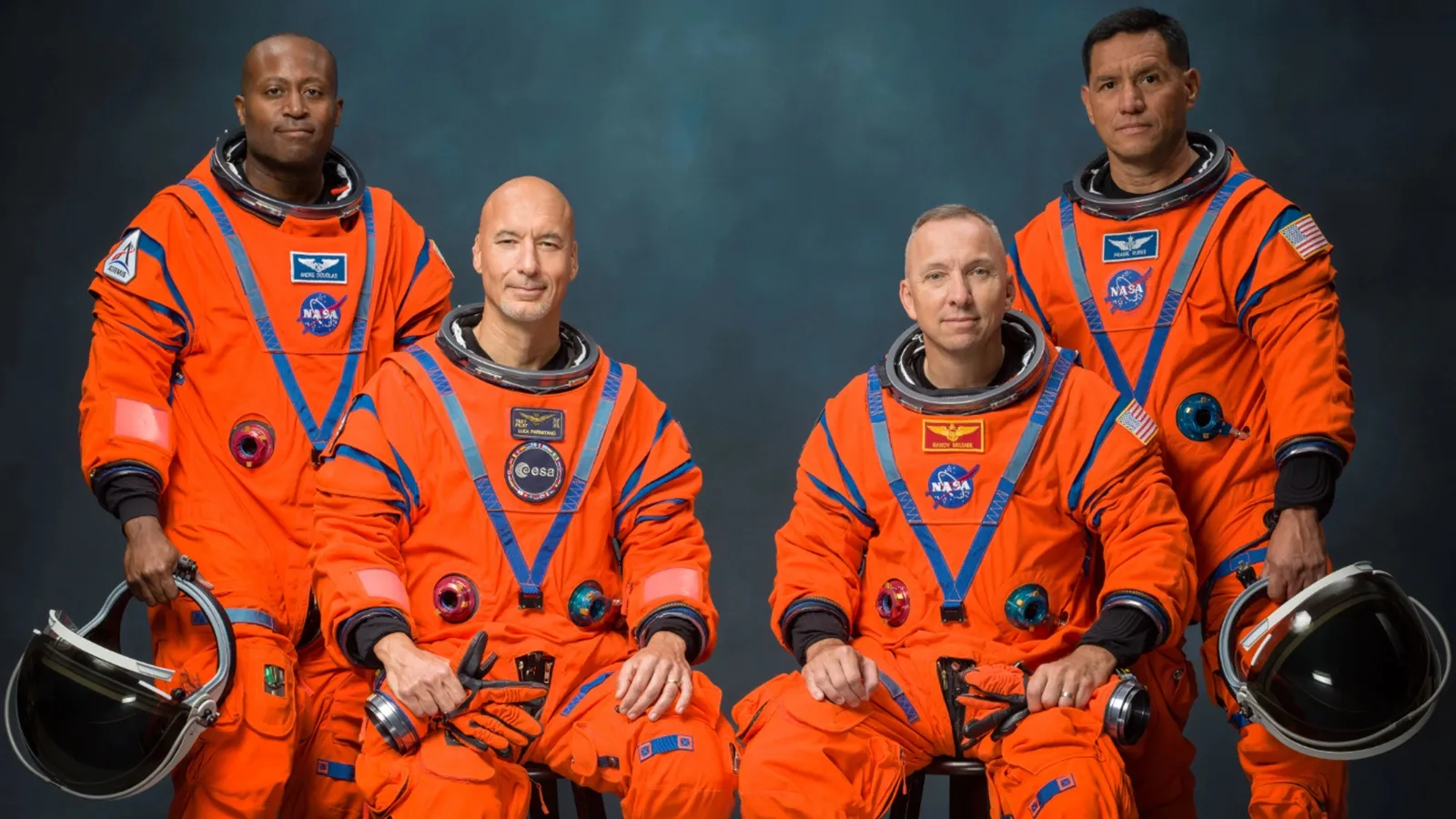
NASA has officially introduced the four astronauts selected for the Artemis III mission, marking another major milestone in its long-term effort to return humans to the Moon and prepare for future missions to Mars. While the crew will not land on the Moon during this mission, their work will be essential in testing the technologies and procedures needed for future lunar exploration.
Meet the Artemis III Crew
The Artemis III crew consists of:
Randy Bresnik (Mission Commander) Frank Rubio (Pilot) Andre Douglas (Mission Specialist) Luca Parmitano of the European Space Agency (Mission Specialist)
NASA Administrator Jared Isaacman congratulated the astronauts during the announcement, wishing them "Godspeed" as they begin preparing for one of the agency's most important test missions.
Mission Focus: Testing Before Landing
Unlike the historic Apollo Moon landings, Artemis III will remain in Earth orbit. The mission's primary objective is to conduct a series of docking demonstrations between NASA's Orion spacecraft and lunar landers currently under development.
These exercises are designed to validate the systems, communication protocols, and operational procedures that astronauts will eventually use during a crewed lunar landing mission.
Although the mission won't travel to the Moon, the technologies tested during Artemis III are expected to play a critical role in enabling future deep-space exploration.
Artemis II Sets the Stage
The announcement comes just two months after the successful Artemis II mission, which completed a record-breaking journey around the Moon. The mission surpassed the distance record previously held by Apollo 13 and demonstrated the capabilities of NASA's Orion spacecraft for long-duration human spaceflight.
The success of Artemis II paved the way for the next phase of testing under Artemis III.
SpaceX and Blue Origin in the Lunar Race
NASA is working with commercial partners to develop the lunar landing systems required for future Moon missions.
Two companies currently leading that effort are:
SpaceX Blue Origin
Both firms are developing human landing systems that will eventually transport astronauts from lunar orbit to the Moon's surface.
Blue Origin recently experienced a setback when one of its large rockets exploded during an engine test at its Florida launch facility. Despite the incident, NASA officials remain optimistic.
NASA's Deputy Associate Administrator Jeremy Parsons described the failure as a valuable learning experience and expressed confidence that Blue Origin's lander program remains on track.
Timeline Toward the Moon
NASA currently aims to launch the two-week Artemis III technology demonstration mission in 2027.
Following that mission, the agency hopes to carry out its first crewed lunar landing since the Apollo era in 2028 as part of an updated Artemis roadmap introduced by Administrator Jared Isaacman.
The revised strategy includes additional testing before committing astronauts to the Moon, reflecting NASA's emphasis on safety and mission readiness.
Looking Beyond the Moon
NASA views the Artemis program as more than a return to the lunar surface.
Earlier this year, the agency awarded hundreds of millions of dollars in contracts to several aerospace companies to develop lunar infrastructure, including:
Surface landers Rovers Autonomous drones
These systems are expected to support the eventual construction of a sustainable Moon base.
According to NASA, experience gained from living and working on the Moon will help prepare astronauts for future missions to Mars.
Astronauts Reflect on the Opportunity
Commander Randy Bresnik said the crew feels honored to represent NASA during such an important stage of human space exploration.
Mission Specialist Andre Douglas described the announcement as an emotional moment, saying his mind was racing with excitement while feeling deeply grateful for the opportunity.
Their comments reflected the significance of participating in a mission that will help shape humanity's next era of exploration beyond Earth.
Conclusion
Although Artemis III will not include a Moon landing, it represents a critical step toward making future lunar missions possible. By validating spacecraft docking procedures, testing next-generation lunar systems, and strengthening partnerships with commercial space companies, NASA is laying the groundwork for sustained human exploration of the Moon—and eventually, Mars.
If the mission proceeds as planned, Artemis III will become one of the most important technology demonstration missions in modern spaceflight, bringing NASA one step closer to returning astronauts to the lunar surface for the first time in more than half a century.