
Everest Legend’s Final Descent, Nirmal Purja’s Body Recovered After Pakistan Avalanche
The body of mountaineer Nirmal Purja was reportedly recovered following an avalanche in Pakistan, marking a tragic end to the incident. The report highlights the recovery while the precise…
Politics
UK Edition
By CMS Admin
🕵 AI Narrative Audit
The headline carries a tragic and emotionally charged framing by emphasizing the mountaineer’s death and recovery while offering little context about the avalanche or circumstances surrounding the incident.
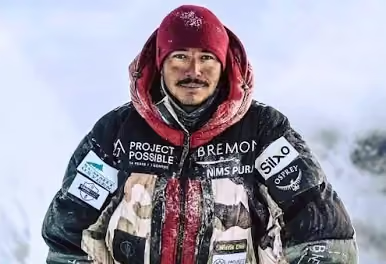
The body of renowned British-Nepali mountaineer Nirmal “Nims” Purja has been recovered from Broad Peak in Pakistan, rescuers have said, days after an avalanche struck a multinational climbing group on the mountain.
The Alpine Club of Pakistan said on Sunday that Purja’s body was found at an altitude of about 5,700 metres. Three other bodies have also been sighted on the mountain, although their identities have not yet been confirmed.
Purja’s death was announced on Saturday by his company, Elite Expeditions, which said he was among 10 climbers killed in the avalanche. Tributes have since been paid by political leaders and fellow mountaineers, including the Prince of Wales.
The 43-year-old, who was born in Nepal and later served in the British Army, became one of the world’s best-known high-altitude mountaineers. In 2019, he climbed all 14 mountains higher than 8,000 metres in just 189 days, breaking the previous record by more than seven years.
Recovery Operation Under Way
The Alpine Club of Pakistan said a ground team would transport the recovered bodies to a Japanese camp as rescue operations continue.
Before Purja’s death was officially announced, Pakistani officials said the bodies of three other climbers from his expedition had been recovered. They were identified as American climber Mallory Geis, Nadhira Ahmed Abdullah Al Harthy of Oman and Pur Bahadur Gurung of Nepal.
Nepal’s Prime Minister Balendra Shah expressed shock over the deaths, saying the loss of six Nepalese and four other foreign climbers had deeply affected the country.
“The history of their courage, dedication, and contributions will always remain inspiring,” Shah said.
Purja’s older brother, Kamal, also paid tribute to him, describing the loss as devastating while saying the family remained proud of his achievements and legacy.
Tributes From Britain and the Mountaineering Community
Prince William said he was “truly saddened” by Purja’s death and praised his distinguished military service before he became one of the world’s leading mountaineers.
UK Defence Secretary Wes Streeting also described Purja as an inspirational figure whose military service and mountaineering achievements had gained worldwide recognition.
Naila Kiani, a spokesperson for the Alpine Club of Pakistan involved in the rescue effort, said Purja had led several expeditions in which she had participated. She described him as a highly experienced and fearless climber with strong leadership skills.
Search teams had been working since Thursday to locate climbers following the avalanche on Broad Peak, the world's 12th-highest mountain. The 8,047-metre peak is located in Pakistan’s Karakoram range.
A Record-Breaking Mountaineer
Purja rose to international prominence in 2019 when he completed the ascent of all 14 eight-thousanders in only 189 days. His achievement was later featured in the Netflix documentary 14 Peaks: Nothing Is Impossible, which introduced his story to a global audience.
He served in the British military for 16 years, including 10 years in the special forces. In 2018, he was awarded an MBE by the late Queen Elizabeth II for his achievements in extreme high-altitude mountaineering.
Purja also became known for breaking barriers as a Gurkha mountaineer and said he was the first Gurkha to climb Mount Everest while serving in the British military.
Broad Peak Expedition
Purja had not initially planned to climb Broad Peak during his latest expedition. In his final post on X, published on Monday, he said his original plan was to climb Gasherbrum II, also known as G2.
He later realised that adding Broad Peak to the expedition could leave him with just one more mountain to climb before becoming the first person to summit all 14 eight-thousanders twice without supplemental oxygen.
Broad Peak rises to 8,047 metres and is considered a demanding mountain for climbers. The first successful ascent took place in 1957, when an Austrian expedition reached its summit.
Although many climbers have successfully climbed Broad Peak since then, the mountain has also claimed numerous lives.
Purja’s final expedition has therefore ended in tragedy, cutting short the ambitions of a mountaineer whose record-breaking achievements had already established him as one of the most prominent figures in modern high-altitude climbing.
Source: Editorial
View Original Source →