
Three Countries, One Defence Pact, Saudi Arabia, Turkey and Pakistan Team Up
Saudi Arabia, Turkey and Pakistan have signed a defence pact, marking a new step in their security cooperation and strategic ties. The agreements significance should be assessed in the context of…
Politics
World Edition
By CMS Admin
🕵 AI Narrative Audit
The headline is largely neutral but could frame the defence pact as a significant strategic development without providing context on the agreements scope, motivations, or how the three countries characterize the partnership.
Saudi Arabia, Turkey and Pakistan have signed a joint defence agreement under which an armed attack against any one of the three countries would be regarded as an attack against all three.
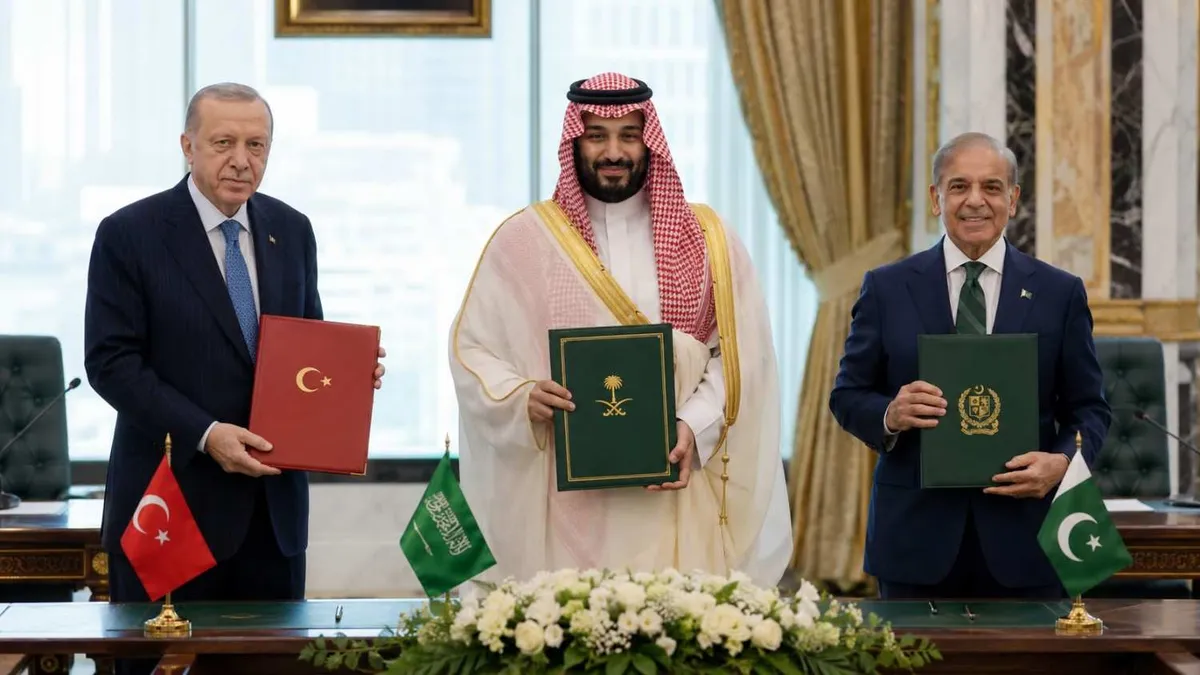
The agreement was announced following a meeting between Saudi Crown Prince Mohammed bin Salman, Turkish President Recep Tayyip Erdogan and Pakistani Prime Minister Shehbaz Sharif in Mecca.
The Mecca Joint Defence Agreement seeks to strengthen security cooperation among the three countries and establish a framework for mutual defence. A joint statement said the pact aims to strengthen collective deterrence against aggression and enhance defence cooperation in multiple areas.
Three-Way Security Partnership
The agreement brings together three influential Muslim majority countries with different strategic interests and military capabilities.
The pact states that an armed attack against any one of the three states would be considered an attack against all of them. However, the agreement does not publicly specify the precise obligations each country would have to undertake in the event of an attack.
A Turkish official cited by Reuters described the agreement as purely defensive in nature.
The pact also provides for expanded cooperation across defence related areas, although details of its implementation and the mechanisms for responding to a potential attack remain limited.
Saudi Arabia Seeks Greater Security
For Saudi Arabia, the agreement comes against the backdrop of heightened security concerns in the Middle East and disruptions to regional maritime routes.
The kingdom has faced growing risks connected to regional conflicts, including threats to shipping and critical infrastructure. The Red Sea and the Strait of Hormuz are particularly important to Saudi Arabia and the wider global energy market because of their role in international oil and commercial shipping.
The new arrangement gives Riyadh another avenue for strengthening its security partnerships at a time when regional alliances and defence strategies are undergoing significant changes.
What Pakistan Gains
For Pakistan, closer defence ties with Saudi Arabia and Turkey could provide additional strategic and economic benefits.
Pakistan has maintained longstanding defence and diplomatic relations with both countries. Turkey brings significant military and defence-industrial capabilities, while Saudi Arabia has considerable economic influence and financial resources.
The agreement therefore provides Pakistan with another framework for strengthening its relationships with two important regional partners.
Turkey’s Strategic Role
Turkey also stands to deepen its defence cooperation with both Saudi Arabia and Pakistan through the agreement.
Ankara has developed a growing defence industry and expanded its security partnerships across the Middle East and beyond. Closer cooperation with Riyadh and Islamabad could create opportunities for greater coordination in areas such as defence technology, training and military cooperation.
Regional Security Implications
The agreement comes at a time of significant geopolitical uncertainty across the Middle East and South Asia.
For Saudi Arabia, the priority is strengthening deterrence and reducing security vulnerabilities. Pakistan has its own strategic concerns, while Turkey continues to expand its role in regional security affairs.
The pact could therefore become an important component of the three countries' broader defence relationships.
At the same time, the agreement should not automatically be interpreted as creating a NATO-style military alliance. Its precise commitments, response mechanisms and practical scope will depend on how the three countries implement the agreement in the future.
A New Chapter in Defence Cooperation
The Mecca agreement marks a significant expansion of security cooperation between Saudi Arabia, Turkey and Pakistan. While the three countries have previously maintained bilateral defence relationships, bringing them together under a mutual-defence framework represents a new development.
The key question now is how the agreement will operate in practice and what specific defence commitments the three governments eventually establish. For now, the pact signals a shared interest in strengthening collective security and deterrence amid an increasingly complicated regional security environment.
Source: Editorial
View Original Source →