
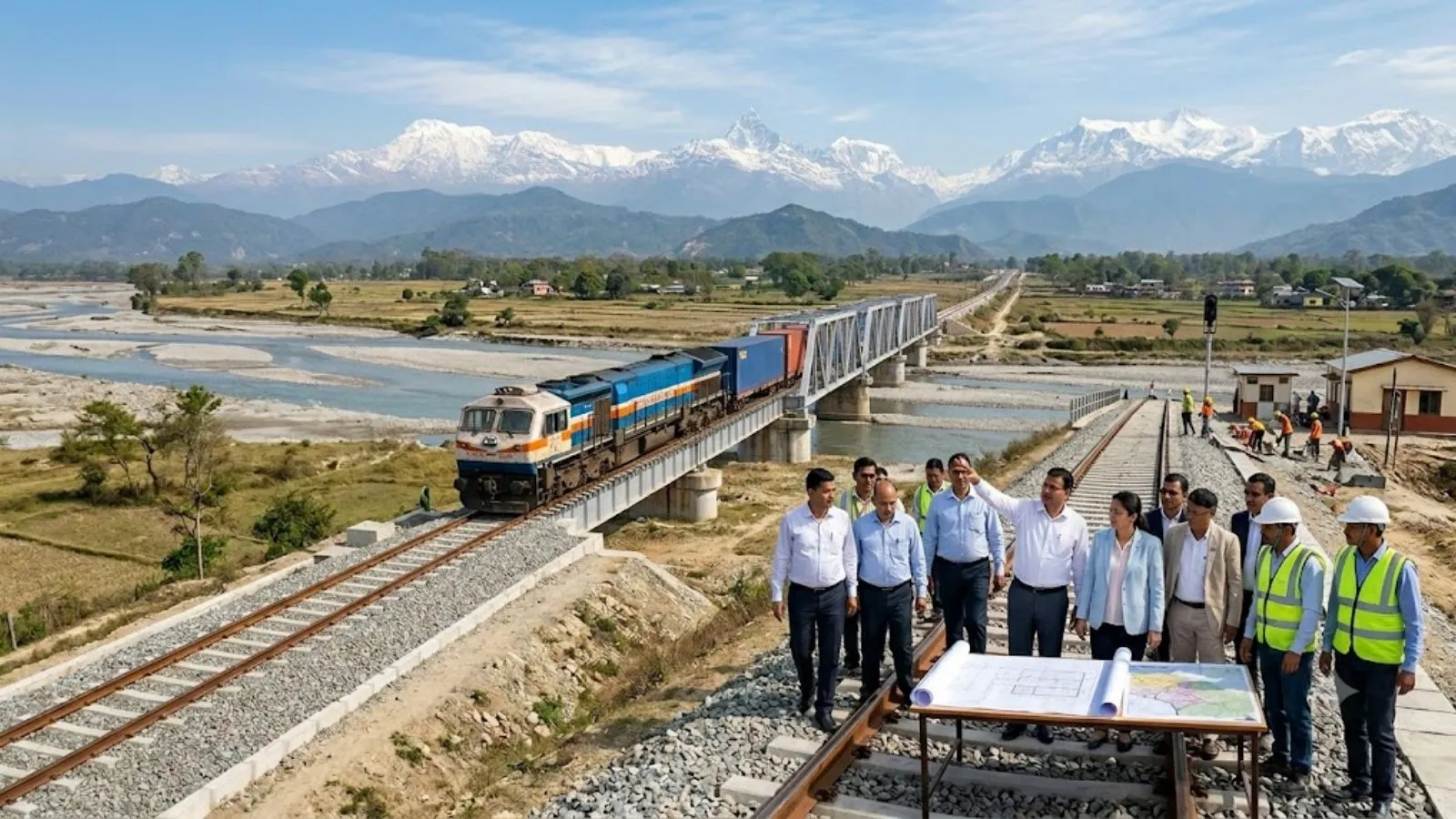
India and Nepal have recently reviewed the progress of multiple cross-border railway projects, including the much-discussed Raxaul–Kathmandu Broad Gauge (BG) railway line, as part of ongoing efforts to strengthen regional connectivity and economic integration. The review meetings highlight continued cooperation between the two countries in expanding rail infrastructure across key border points.
High-Level Meetings in Kathmandu
The discussions took place during the 10th Project Steering Committee (PSC) and the 8th Joint Working Group (JWG) meetings held in Kathmandu on June 11–12, 2026. These sessions focused on assessing current progress, resolving implementation challenges, and aligning timelines for ongoing railway projects under bilateral cooperation frameworks.
According to a statement issued by the Indian Embassy in Nepal, both sides reiterated their commitment to enhancing cross-border transport infrastructure as a means to improve trade, mobility, and people-to-people connectivity.
Raxaul–Kathmandu Railway Line
A major focus of the discussions was the proposed Raxaul–Kathmandu BG railway line, which is envisioned as a strategic link connecting India’s border town of Raxaul with Nepal’s capital Kathmandu. The project is considered one of the most ambitious rail connectivity initiatives between the two countries, aimed at significantly reducing travel time and boosting regional economic activity.
Officials reviewed the status of feasibility assessments, alignment studies, and preparatory work required for future phases of construction. While the project remains in planning and coordination stages, it continues to be a central pillar of India–Nepal transport cooperation.
Other Key Railway Projects
In addition to the Raxaul–Kathmandu line, both sides also reviewed progress on several other important railway corridors, including:
Jaynagar–Bijalpura–Bardibas BG railway line Jogbani–Biratnagar BG railway line
These projects are being developed with grant assistance from the Government of India and are intended to improve regional connectivity within Nepal while strengthening cross-border trade routes.
Passenger Service Expansion Plans
Another important topic of discussion was the formulation of Standard Operating Procedures (SOPs) for the commencement of passenger train services on the Janakpur–Ayodhya route. This proposed service is expected to enhance cultural and religious tourism connectivity between the two countries, particularly along historically significant routes.
Strategic Importance
Rail connectivity projects between India and Nepal are seen as vital components of broader regional development strategy. They aim to improve logistics efficiency, support economic growth in border regions, and deepen bilateral cooperation in infrastructure development.
The Raxaul–Kathmandu project, in particular, is viewed as a long-term transformative link that could significantly reshape mobility between the Indian plains and Nepal’s capital region once completed.
Conclusion
The latest PSC and JWG meetings underscore continued momentum in India–Nepal railway collaboration. While many projects remain under development, ongoing reviews and coordination efforts indicate sustained commitment from both sides to advance cross-border rail connectivity in the coming years.