
E20 Controversy Shifts Gears as Kejriwal Accuses Centre of Giving Trump the Green Light
Arvind Kejriwal has alleged that the Centre’s decision to promote E20 fuel was influenced by pressure from US President Donald Trump. The claim represents Kejriwal’s political interpretation of the…
Politics
Indian Edition
By CMS Admin
🕵 AI Narrative Audit
The headline accurately attributes the yielded to Trump claim to Arvind Kejriwal but uses politically charged wording that may frame the Centre’s E20 policy as a concession without presenting the government’s perspective.
New Delhi: Aam Aadmi Party (AAP) national convenor Arvind Kejriwal has announced that he will march to Prime Minister Narendra Modi’s residence on Tuesday, August 4, along with 100 people, to submit petitions opposing the use of E20 fuel.
Kejriwal said the move was aimed at raising concerns over the government’s continued push for petrol blended with up to 20% ethanol. He alleged that the Centre was promoting the policy under pressure from U.S. President Donald Trump.
Kejriwal announces protest over E20 fuel
According to Kejriwal, the group will approach the Prime Minister’s residence to submit petitions against E20 fuel. The proposed march comes amid an ongoing political debate over ethanol blending in petrol and its impact on consumers.
The AAP leader has questioned the government's approach to ethanol-blended petrol and argued that the policy requires greater scrutiny.
The protest is expected to focus on the government's ethanol-blending programme and the concerns raised by motorists and political parties over the transition to E20 fuel.
Kejriwal alleges US pressure
Kejriwal alleged that India had “yielded” to Trump to purchase ethanol from the United States. He further claimed that the continued push for ethanol-blended petrol pointed towards what he described as a “hidden agenda”.
The allegations were made by Kejriwal as part of his criticism of the Centre's fuel policy. However, the claims represent his political position and do not, by themselves, establish that the E20 policy was introduced as a result of U.S. pressure.
The government's policy decisions on ethanol blending have broader objectives related to fuel imports, agriculture, energy security and emissions, making the issue part of a wider economic and energy-policy debate.
What is E20 fuel?
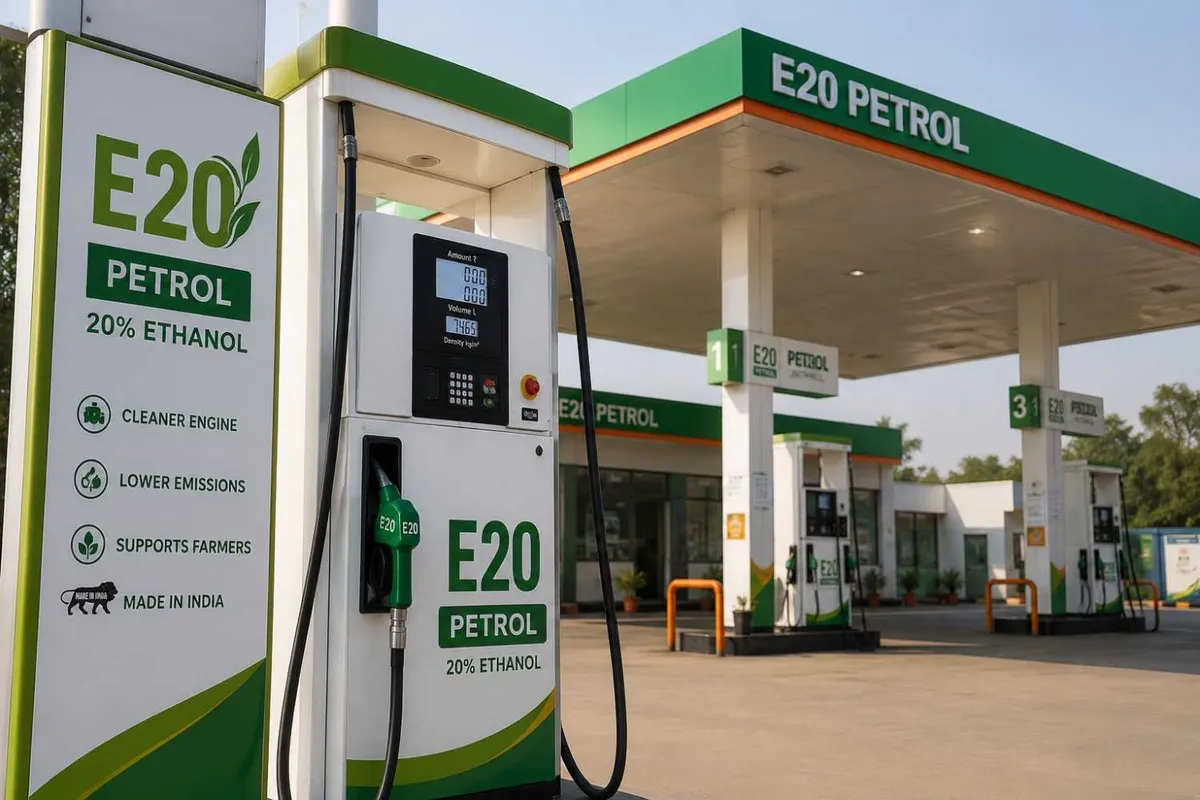
E20 refers to petrol containing 20% ethanol blended with 80% petrol. Ethanol is an alcohol-based fuel that can be produced from agricultural feedstocks and other sources.
India has been increasing ethanol blending in petrol as part of its efforts to reduce dependence on imported crude oil and expand the use of domestically produced renewable fuel.
The programme has also been linked to opportunities for farmers and the sugar and grain sectors, which can supply feedstock for ethanol production.
Why the issue has become political
The expansion of ethanol blending has attracted political attention because vehicles and fuel systems have historically been designed around different petrol formulations.
Critics have raised questions about vehicle compatibility, fuel efficiency and the impact of higher ethanol blends on motorists. Supporters of the programme, meanwhile, point to potential benefits in terms of reducing fossil-fuel dependence and strengthening domestic energy security.
The political disagreement has intensified as E20 fuel becomes more widely available.
AAP's planned march
Kejriwal said he would be accompanied by 100 people during the proposed march on August 4. The group plans to submit petitions outlining its objections to E20 fuel.
The announcement adds another political dimension to the wider debate over India's fuel-blending programme.
The proposed action also puts the spotlight on how the government responds to concerns surrounding E20 and whether further clarification is provided on the policy's economic, environmental and consumer implications.
The larger ethanol debate
India's ethanol-blending programme is part of a longer-term effort to diversify the country's fuel mix. Increasing ethanol use can potentially reduce the quantity of petrol required from crude-oil imports while creating an additional market for domestic agricultural produce.
At the same time, the transition requires attention to vehicle compatibility, fuel standards, consumer awareness and the availability of suitable blends.
The debate over E20 is therefore not limited to politics. It involves questions about energy security, agriculture, the automobile industry, fuel prices and the long-term direction of India's energy policy.
What happens next?
Kejriwal's planned march and petition submission are likely to keep E20 fuel in the political spotlight. The Centre's response to the allegations and the concerns raised by opponents of the policy will be important in shaping the next phase of the debate.
For consumers, the key issues remain the practical impact of E20 fuel, vehicle compatibility, fuel efficiency and the broader costs and benefits of ethanol blending.
As the government continues its ethanol-blending programme, the political debate is likely to continue alongside discussions about India's energy security and its transition towards alternative fuel sources.
Source: Editorial
View Original Source →