
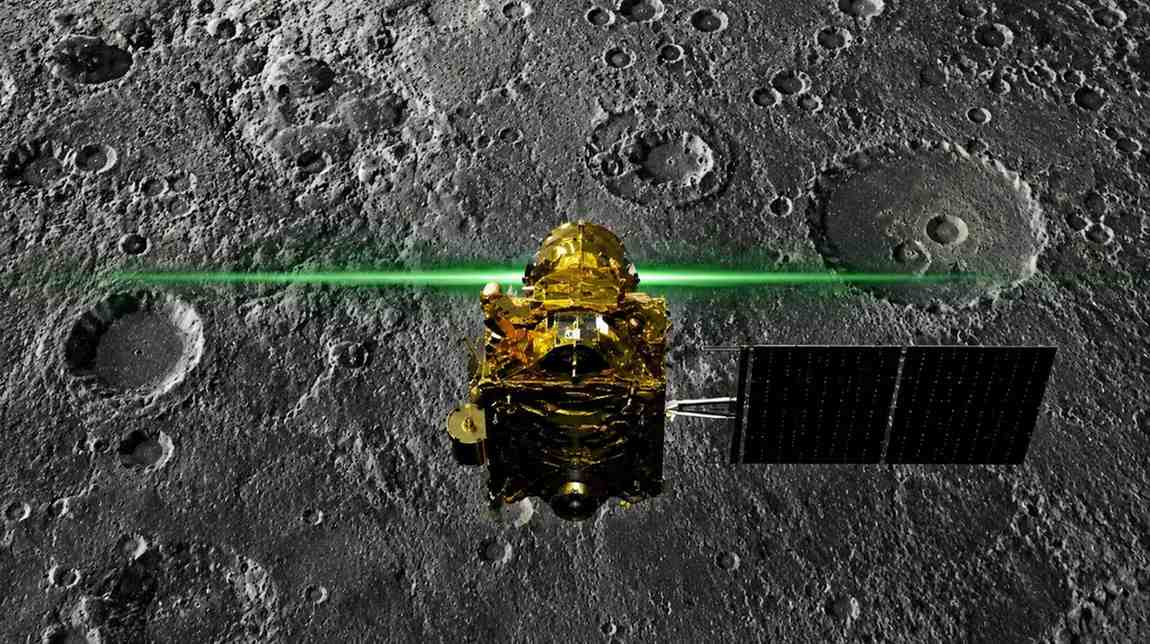
Chandrayaan-3 Finds Moon Soil at Shiv Shakti Point Closely Matches Antarctic Lunar Meteorite
India's Chandrayaan-3 mission continues to reshape our understanding of the Moon. In a significant scientific breakthrough, researchers have discovered that the lunar soil collected at Shiv Shakti Point—the mission's historic landing site near the Moon's South Pole—shares a remarkably close chemical composition with a lunar meteorite discovered in Antarctica more than four decades ago.
The findings not only offer fresh insights into the Moon's geological history but also strengthen theories about how massive asteroid impacts have shaped the lunar surface over billions of years.
A Landmark Discovery from Chandrayaan-3
Scientists from the Physical Research Laboratory (PRL) analyzed data collected by the Alpha Particle X-ray Spectrometer (APXS) aboard the Pragyan rover. Their research revealed that the soil at Shiv Shakti Point is rich in iron and magnesium while containing comparatively lower amounts of aluminum.
This chemical signature closely resembles that of the lunar meteorite ALHA 81005, which was discovered in Antarctica's Allan Hills region in 1982. Scientists believe the meteorite was blasted off the Moon by a powerful impact before eventually landing on Earth around one million years ago.
According to the researchers, this is one of the strongest chemical matches ever observed between an in-situ lunar sample and a lunar meteorite found on Earth.
What Makes Shiv Shakti Point Special?
Shiv Shakti Point became globally significant in August 2023 when Chandrayaan-3 successfully achieved the world's first soft landing near the Moon's South Pole.
Unlike many earlier lunar missions that explored equatorial regions, Chandrayaan-3 investigated an area believed to preserve valuable clues about the Moon's ancient interior and its geological evolution.
The latest research suggests that the soil in this region differs noticeably from many previously studied lunar highland areas.
Understanding the Chemical Match
Researchers found that both the Shiv Shakti Point soil and the Antarctic meteorite contain:
High concentrations of iron oxides High magnesium-rich minerals Relatively low aluminum oxide
The Antarctic meteorite contains approximately:
25.8% Aluminum Oxide 13.7% Iron and Magnesium Oxides
Measurements taken by Chandrayaan-3's APXS instrument showed a remarkably similar chemical composition, making ALHA 81005 one of the closest known matches.
Evidence of Material from Deep Inside the Moon
One of the study's most exciting conclusions is that the soil around Shiv Shakti Point may contain material originating from much deeper beneath the Moon's surface.
Normally, the Moon's upper layer—known as the regolith—is formed by billions of years of meteorite impacts that grind rocks into fine dust.
However, the elevated levels of iron and magnesium suggest that ancient impact events may have excavated deeper mineral layers and mixed them into the surface soil.
This provides valuable evidence supporting long-standing theories about lunar geological processes.
The Role of the South Pole–Aitken Basin
Scientists believe the nearby South Pole–Aitken (SPA) Basin played a major role in creating this unusual composition.
The SPA Basin is one of the largest and deepest impact craters in the entire Solar System.
Researchers propose that the enormous asteroid impact that formed this basin excavated rocks from deep inside the Moon and scattered them across surrounding regions, including the Chandrayaan-3 landing site.
The chemical composition measured by Pragyan strongly supports this hypothesis.
Comparing Lunar Meteorites from Around the World
The research team didn't limit its analysis to the Antarctic meteorite alone.
Scientists also compared Chandrayaan-3's findings with lunar meteorites recovered from:
Northwest Africa Libya Oman
These meteorites were selected because they also contain relatively high concentrations of magnesium and iron, making them useful references for studying the Moon's farside crust.
Among all the meteorites examined, ALHA 81005 remained the closest chemical match to the soil at Shiv Shakti Point.
Importance of the APXS Instrument
The Alpha Particle X-ray Spectrometer (APXS) mounted on the Pragyan rover played a crucial role in this discovery.
The instrument determines the chemical composition of rocks and soil by measuring the X-rays emitted after they are bombarded with alpha particles.
Its precise measurements have enabled scientists to conduct one of the most detailed chemical analyses ever performed directly on the lunar surface.
Why This Discovery Matters
The findings have several important implications:
They provide direct evidence that deep lunar materials have reached the surface. They improve scientists' understanding of the Moon's geological evolution. They help connect meteorites found on Earth with their original locations on the Moon. They validate the scientific capabilities of India's Chandrayaan-3 mission. They contribute valuable data for future lunar exploration and sample-return missions. A Major Achievement for Indian Space Science
Chandrayaan-3 has already secured its place in history by becoming the first mission to land successfully near the Moon's South Pole.
Now, its scientific instruments are producing discoveries that are advancing planetary science worldwide. The close chemical relationship between Shiv Shakti Point's soil and the Antarctic lunar meteorite provides new evidence about how ancient impacts shaped the Moon and offers researchers a better understanding of its hidden interior.
As scientists continue analyzing Chandrayaan-3's data, the mission is expected to deliver even more discoveries that will deepen humanity's knowledge of Earth's closest celestial neighbor.