
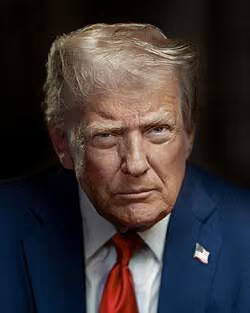
U.S. President Donald Trump has turned to India’s election system to strengthen his argument for stricter voter-identification rules in the United States, pointing to India’s use of photo identification during elections as an example for American policymakers.
In a post on Truth Social, Trump referred to a recent interaction involving India’s Chief Election Commissioner Gyanesh Kumar. Trump said Kumar had questioned how elections could be conducted in the United States without a valid photo ID requirement. Using the comparison, Trump renewed his call for Congress to pass the SAVE America Act, legislation that seeks tighter voter-registration and identification requirements for federal elections.
Trump points to India’s massive electorate
Trump highlighted the scale of India electoral exercise, noting that around 646 million people voted in India’s 2024 general election. He also pointed to the relatively small share of voters who used postal ballots and the requirement for voters to present valid photo identification.
For Trump, the Indian example provides an argument that a huge democracy can operate with extensive voter identification requirements. He has repeatedly argued that stronger identification rules would help protect the integrity of American elections and prevent electoral fraud.
What is the SAVE America Act?
The Safeguard American Voter Eligibility (SAVE) America Act is aimed at strengthening voter-registration requirements in federal elections. Among its key provisions are requirements involving proof of U.S. citizenship and voter identification, along with restrictions on voting by mail. Trump has made passage of the legislation a major part of his election-policy agenda.
Trump and his supporters argue that stricter identification and citizenship verification would strengthen confidence in the electoral process. Critics, however, contend that additional documentation requirements could make voting more difficult for some eligible Americans.
India becomes an unlikely reference point
Trump comments have placed India at the centre of an American political debate over election administration. India conducts elections on an enormous scale, with hundreds of millions of voters participating across the country.
The comparison, however, is not as simple as saying the two systems are identical. India and the United States have different constitutional structures, election-administration systems and voting procedures. In the U.S., election administration is largely handled at the state level, resulting in differences in identification and voting rules from one state to another.
That distinction is important because a policy that works within India's electoral framework cannot automatically be transferred to the American system.
Debate over the comparison
Trump India comparison has also attracted criticism. American journalist Ishaan Tharoor argued that focusing only on voter ID overlooks other aspects of India's electoral system, particularly debates surrounding voter rolls and the removal or addition of names to electoral lists.
The disagreement illustrates the broader political divide surrounding voter identification in America. Supporters see identification requirement as a basic safeguard for elections, while critics warn that complicated documentation requirements can create additional barriers for eligible voters.
India’s election system under the spotlight
The episode is notable because India, which is often closely watched for the sheer scale of its elections, is now being invoked by an American president as a reference point in a domestic political debate.
Trump's message is essentially straightforward: if the world's largest democracy can require voters to establish their identity, he argue, the United States should consider stronger nationwide requirements as well.
Whether Congress ultimately adopts the SAVE America Act remains a matter of political and legal debate. But Trump's latest remarks have ensured that India's voter-identification system is once again part of the conversation not just in New Delhi, but in Washington too.
The irony is hard to miss- America, which has long been viewed as a model of democracy around the world, is now being asked by its own president to take an electoral lesson from India.