
Ukraine Takes the War Deep Into Russia, Two Oil Refineries Get an Unwanted Visit
The report highlights Ukraine’s reported strikes on two Russian oil refineries but does not establish the full extent of the damage or independently verify the details of the attacks. A balanced…
Politics
World Edition
By CMS Admin
🕵 AI Narrative Audit
The framing emphasizes Ukraine’s ability to strike deep inside Russian territory but provides limited context on the evidence for the attacks, the damage caused, Russia’s response, or the broader military context.
Ukraine said it carried out multiple strikes deep inside Russian territory, hitting two oil refineries and targeting vessels in the Black Sea as Kyiv seeks to put pressure on infrastructure it says supports Moscow’s war effort.
President Volodymyr Zelensky said the Bashneft-Novoil refinery in Russia’s Bashkortostan republic and the Slavneft-Yanos refinery in Yaroslavl region were targeted. He said the attacks were aimed at limiting oil revenues that Moscow uses to finance its war against Ukraine.
Zelensky said the Bashneft-Novoil facility was around 1,300km (808 miles) from the Ukrainian border, while Slavneft Yanos was almost 700km (435 miles) away, highlighting the considerable distance of the reported attacks from the front line.
Fire Reported at Yaroslavl Refinery
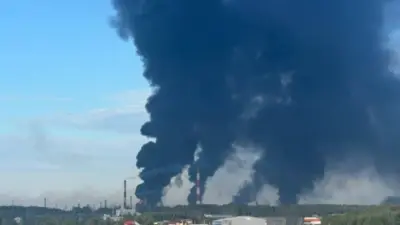
Yaroslavl regional governor Mikhail Evraev said the Slavneft Yanos refinery caught fire following what he described as the regions largest enemy drone attack.
Evraev said four people were injured and that 93 drones had been shot down over the Yaroslavl region overnight. He said falling debris struck storage tanks at the refinery and that emergency services were working to extinguish the fire.
BBC Verify confirmed multiple images and videos shared online showing large plumes of smoke rising from the refinery. At least four separate fires appeared to be visible in one of the verified images.
The Yaroslavl region’s energy-generating infrastructure has previously been targeted in attacks attributed to Ukraine.
Authorities in Bashkortostan had not publicly commented on the reported attack on the Bashneft-Novoil refinery on August 5.
Black Sea Vessels Also Targeted
Ukraine also said that two military patrol boats and vessels associated with what it described as Russia’s “shadow fleet” were hit in the Black Sea.
Zelensky referred to the shadow fleet as tankers used by Russia to export sanctioned oil. He said the attacks were intended to increase pressure on Russia’s ability to generate revenue from its energy exports.
Russia must choose peace, Zelensky said, arguing that Ukrainian attacks were strengthening the prospects for diplomacy.
The claims concerning the vessels were part of Ukraine’s account of the latest attacks, while the full extent of the reported damage was not immediately clear.
Russia Reports Strikes on Ukrainian Infrastructure
The latest Ukrainian strikes came alongside continued Russian attacks across Ukraine.
Ukraine said at least 11 people were killed in Russian attacks, while the southern city of Kherson experienced a total power blackout after a critical infrastructure facility was hit.
Russia said its forces had targeted Ukrainian fuel, energy and transport facilities, as well as sites used to store drones.
The Russian military also said its forces had intercepted or shot down 605 Ukrainian drones overnight across several regions.
Casualties Reported Across Ukraine
In the Kharkiv region, Ukraine state emergencies service said three people were killed in an overnight Russian drone attack in Balakliya. Residential buildings were reportedly targeted, with fires breaking out at two houses.
Kharkiv regional head Oleh Synehubov later said another two people were killed when drones struck the train station in Lozova, while eight others were injured.
In the central Dnipropetrovsk region, local officials reported that five people were killed in Russian strikes later on Thursday.
In Odesa, a major Black Sea port, one person was reportedly killed after Russia struck two dry-cargo ships.
The attacks underline the continuing risks faced by civilian areas and infrastructure far from the main front line.
Kherson Hit by Power Outage
Kherson was also affected by the latest Russian strikes, with the entire city losing electricity after a “critical infrastructure facility” was hit overnight, according to regional head Oleksandr Prokudin.
Internet monitoring group NetBlocks told BBC Verify that connectivity in the Kherson region experienced significant disruption. Its telemetry showed internet connectivity falling to about 31% at its lowest point overnight before recovering to around 69% by 12:00 GMT.
NetBlocks research head Isik Mater said connectivity did not fall completely to zero, partly because generators and backup supplies were being used.
War Continues Despite Stalled Front Line
The latest exchange of attacks comes as Russia and Ukraine have intensified strikes against major cities, energy infrastructure, warehouses and other strategic targets.
The main front line has remained largely static in recent weeks, despite continued fighting. Efforts at mediation have also failed to produce a breakthrough capable of ending the conflict.
Russia launched its full-scale invasion of Ukraine in February 2022, beginning a war that has continued for more than four years.
Ukraine’s latest attacks demonstrate Kyiv’s continuing ability and willingness to target infrastructure far inside Russian territory, while Russia continues to strike Ukrainian energy, transport and military-related facilities.
The competing claims from Moscow and Kyiv highlight the increasingly wide geographical reach of the conflict. As both sides continue targeting infrastructure and logistical networks, the latest attacks show that areas far from the battlefield remain vulnerable to military action.
Source: Editorial
View Original Source →