
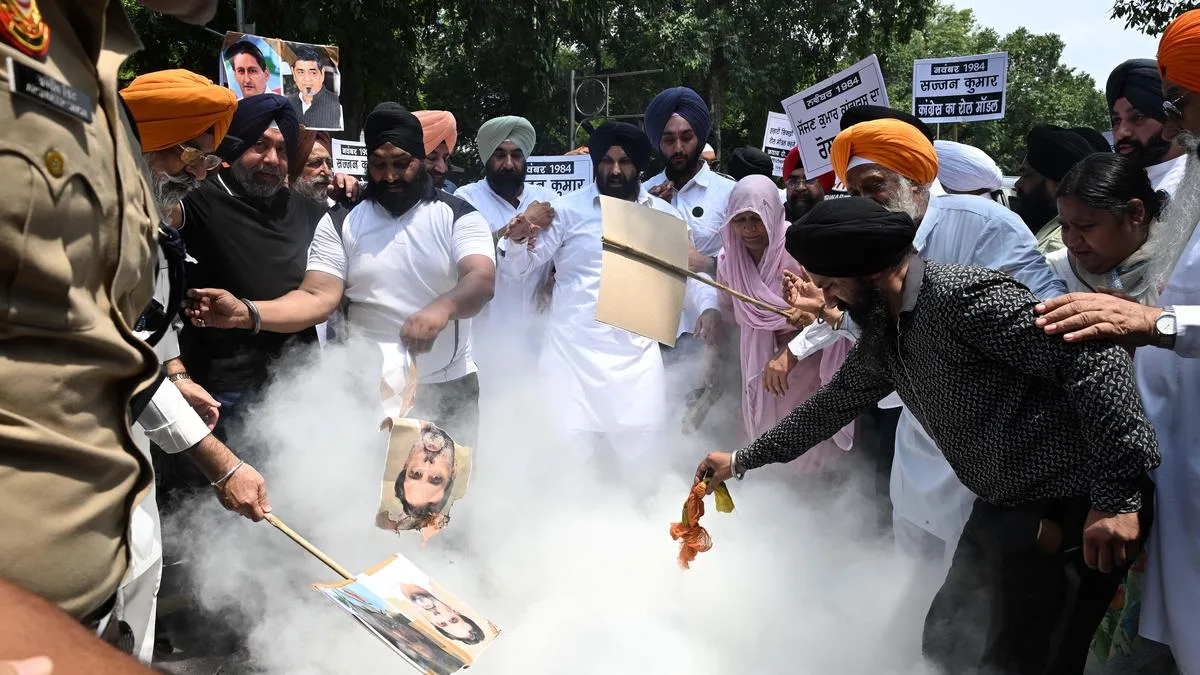
A fresh political controversy erupted in New Delhi on Saturday, August 22, 2026, after more than 200 Sikh community representatives, including families of victims of the 1984 anti Sikh violence, gathered near Congress leader Rahul Gandhi’s residence to protest remarks allegedly describing former Congress MP Sajjan Kumar as a “party role model.”
The protesters burned an effigy of Mr. Gandhi and struck it with slippers, expressing anger over what they said was an insult to families who have spent decades seeking justice for victims of the 1984 violence.
Protest Erupts After Sajjan Kumar’s Death
The demonstration came two days after Sajjan Kumar, a former Congress MP who was convicted in connection with the 1984 anti Sikh riots, died.
The timing of the protest added another layer to an already sensitive political issue. Sikh community representatives said the alleged remarks attributed to Rahul Gandhi were deeply offensive because of Kumar’s association with the violence and the long running legal battle surrounding the case.
According to the protester, describing Kumar as a party role model amounted to disrespecting the victims and their families.
Demand for Apology and Resignation
The protesters called for a formal apology from Rahul Gandhi and also demanded his resignation
They argued that Congress leaders should acknowledge the pain of families who have spent decades pursuing accountability for the violence that followed the assassination of former Prime Minister Indira Gandhi in 1984.
For the demonstrators, the controversy was not simply about a political statement. They said it touched upon a much deeper issue of justice, accountability and the treatment of the victims families.
Political Controversy Over the Remark
The alleged role model description has become the central point of the dispute. However, establishing the exact wording and context of any statement is important before drawing conclusions about what was intended.
The protesters interpreted the remarks as praise for Sajjan Kumar, while the wider political debate is likely to focus on what Rahul Gandhi actually said, the circumstances in which he said it, and whether the description was accurately reported.
This distinction is particularly important given the sensitivity surrounding the 1984 violence.
The Long Shadow of 1984
The anti-Sikh violence of 1984 remains one of the most painful episodes in India's political history. Thousands of people were killed in violence targeting Sikh communities in Delhi and other parts of the country following Indira Gandhi assassination.
For survivors and victims families, questions surrounding accountability have remained emotionally and politically significant for decades.
Sajjan Kumar conviction in a 1984 riot case became an important part of that long running legal process. His death has now brought renewed attention to both his political legacy and the continuing sensitivities surrounding the violence.
A Protest With a Strong Political Message
Burning an effigy of a political leader is a highly confrontational form of protest, and Saturday's demonstration clearly conveyed the depth of anger among those participating.
The protesters demands also put political pressure on the Congress leadership, particularly over how the party addresses historical allegations and the concerns of Sikh victims families.
At the same time, the controversy highlights how references to figures associated with the 1984 violence can quickly reopen long standing wounds.
What Happens Next?
The immediate question is whether Rahul Gandhi or the Congress leadership will respond to the protesters demand for an apology.
The controversy could also intensify political debate over the Congress's historical handling of the 1984 violence and its relationship with Sikh voters and community organisation.
For now, the protest has once again brought the legacy of 1984 into the centre of political discourse with an alleged remark about a controversial former Congress leader becoming the latest flashpoint between the party and Sikh community representatives.