
Politics
World Edition
AfD Wins Big, Merz Hits Back, Germany Political Circus Gets Louder
The debate reflects a sharp confrontation over the AfD historic electoral gains, with Merz focusing on its migration and Russia related position while rejecting the prospect of the party securing…
CMS Admin
Editorial · Honestly Biased
AI Narrative Bias Audit
The headline uses confrontational and dramatic framing, emphasizing Merz attack and a stormy debate while portraying the AfD electoral success primarily through its far right label, with limited attention to the broader voter concerns behind its strong performance.
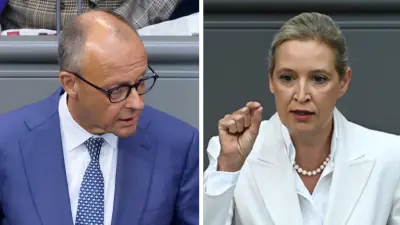
German Chancellor Friedrich Merz has clashed sharply with Alternative for Germany (AfD) leader Alice Weidel in parliament, days after the anti immigration party secured a major electoral victory in the eastern state of Saxony Anhalt.
Addressing the Bundestag, Merz described the AfD as a destructive force and strongly criticised its migration and remigration policies. He argued that the party proposals could have serious consequences for Germany's skilled workforce, pointing out that around one in six skilled workers has a migration background.
AfD Scores Nearly 44% in Saxony Anhalt
The confrontation followed a striking election result in Saxony Anhalt, where the AfD won almost 44% of the vote. Merz conservative CDU, meanwhile, saw its support fall sharply to around 17%.
The AfD fell three seats short of an outright majority, meaning it cannot govern alone and must now consider whether it can secure support from another party. Its success nevertheless represents a significant challenge to Germany long standing political convention of keeping the far right out of state and federal government.
No far right party has previously taken power in any of Germany 16 states since the end of World War Two.
Merz acknowledged the scale of the result, describing it as a seismic political development that has changed the country political landscape.
Weidel Declares Merz Coalition a Failure
Opening the Bundestag session, Weidel attacked Merz government and described the CDU election performance in Saxony Anhalt as a major defeat.
She argued that voters had rejected the chancellor coalition with the centre left Social Democrats and suggested that Merz political time was running out. Weidel also linked migration to concerns over violence and public safety, citing incidents involving knives and attacks on public transport.
Merz rejected the AfD argument and countered that the party migration policies could damage Germany economy.
He warned that large scale departures of workers with migration backgrounds could leave essential sectors such as healthcare, care homes and restaurants struggling to operate.
Migration Becomes Central Battleground
Migration was at the heart of the confrontation.
The AfD has promoted a policy of deportation and remigration, targeting irregular migrants and advocating a significant change in Germany approach to immigration. The party Saxony Anhalt branch has also been classified as right wing extremist by Germany domestic intelligence service.
Merz argued that the policy would affect far more people than the AfD suggests and accused the party of creating a distinction based on people background and origin.
The exchange illustrates the increasingly difficult political debate surrounding immigration in Germany, where concerns about integration, security and labour shortages are colliding with demands for stricter border controls and deportations.
Russia Policy Adds Another Point of Conflict
Migration was not the only issue dividing the two sides.
Merz also accused the AfD of damaging German interests through its support for Russia. The disagreement reflects a wider divide over Germany position toward Moscow and the country role in European security.
The AfD's growing influence has also attracted attention beyond Germany. US President Donald Trump praised the party election performance, linking its success to what he described as Germany failed immigration policies.
Can the AfD Form a Government?
Despite its huge vote share, the AfD still faces a major obstacle: it does not have enough seats to govern alone.
The party has indicated that it is open to working with another political force if that party support its candidate, Ulrich Siegmund, for state premier. One possibility could involve cooperation with the left wing populist BSW.
Siegmund deputy has even suggested that cooperation with Merz CDU could be possible if the conservatives abandoned Germany firewall policy, known as the Brandmauer, which prevents mainstream parties from cooperating with the far right.
For now, however, Germany established parties remain under pressure to decide how they will respond to the AfD growing electoral strength without normalising cooperation with it.
A New Political Reality for Germany
The Bundestag confrontation demonstrates how dramatically Germany political debate has shifted.
The AfD result in Saxony Anhalt has given the party renewed momentum, while Merz conservatives face pressure to address voters concerns over migration, the economy and public security without abandoning their opposition to far right rule.
Whether the AfD can translate its electoral breakthrough into political power in Saxony Anhalt remains uncertain. But its near 44% result has already forced Germany's political establishment to confront a new reality: the far right is no longer a marginal force in parts of the country, and its growing support is reshaping the n
Distribute This Chronicle
Independent commentary breaks corporate silence when readers circulate the ledger directly to their peers.
Attribution: Editorial
Examine Raw Source