
Politics
Indian Edition
Article 142, The Supreme Court Complete Justice Clause Gets a NEET Protest Workout
The report explains Article 142 as a constitutional provision allowing the Supreme Court to pass orders necessary to ensure complete justice, including its use in the context of quashing FIR against…
CMS Admin
Editorial · Honestly Biased
AI Narrative Bias Audit
The headline is mildly sensationalist, portraying Article 142 as a powerful legal shortcut while simplifying the Supreme Court constitutional authority and potentially overstating the significance of it's use in quashing the FIR.
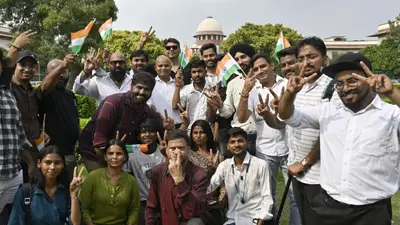
New Delhi, September 2026- The Supreme Court took an extraordinary step on Tuesday, September 1, 2026, quashing criminal cases registered against Gen Z protesters involved in nationwide demonstrations linked to the Cockroach Janta Party (CJP) following the NEET-UG 2026 question paper leak.
The move immediately put Article 142 of the Constitution in the spotlight a provision that gives the Supreme Court broad powers to pass orders necessary to ensure complete justice in matters before it.
In this case, a three judge Bench headed by Chief Justice of India Surya Kant used Article 142 to order that the FIRs against the protesters would not be investigated and would effectively be closed.
Because apparently, when ordinary legal procedures become complicated, the Constitution has a button labelled Complete Justice.
So, What Exactly Is Article 142?
Article 142 is a constitutional provision that empowers the Supreme Court to pass orders necessary for doing complete justice in any case or matter before it.
The provision is designed to allow the country's highest court to provide effective remedies when existing legal procedures may not be enough to deliver justice in a particular case.
It is a powerful constitutional tool but not quite a legal remote control with unlimited buttons.
The Supreme Court has repeatedly clarified that Article 142 is meant to advance justice rather than replace the law itself.
In other words, the provision gives the court considerable flexibility, but that flexibility still operates within constitutional and legal boundaries.
Article 142 Meets the NEET Protest FIRs
The latest case involved criminal cases registered against protesters following demonstrations connected with the NEET-UG 2026 paper-leak controversy.
The Supreme Court's Bench headed by CJI Surya Kant invoked Article 142 and directed that the FIR would not be investigated and would be closed for all intents and purposes.
That means the cases will not proceed through the usual investigative process.
For the protesters, it represents a major legal relief.
For everyone trying to understand Article 142, however, it raises a bigger question-
How much power does the Supreme Court actually have under this provision?
Is Article 142 an Unlimited Power?
Despite its broad wording, Article 142 does not mean the Supreme Court can simply ignore every law whenever it chooses.
The power is intended to help the court ensure justice in particular cases where ordinary legal mechanisms may not provide an adequate remedy.
The court has also emphasised that Article 142 cannot be used to defeat fundamental rights or substantive statutory provisions.
So while it may look like the constitutional equivalent of a giant Delete Case button, there are still legal rules attached to the instruction manual.
Why Does the Provision Matter?
Article 142 has been used by the Supreme Court in several significant cases over the years.
Its importance comes from the fact that courts sometimes encounter situations where following ordinary procedures mechanically could produce an outcome that does not adequately address the circumstances of a case.
Article 142 gives the Supreme Court additional flexibility to craft a remedy.
That flexibility can be extremely useful.
It can also attract debate because such broad judicial powers inevitably raise questions about the limits of judicial authority.
And that is where the fine print becomes more interesting than the headline.
The Constitutional Heavy Machinery
The NEET protest case demonstrates why Article 142 continues to attract attention.
The Supreme Court did not merely interpret an existing rule, it used its constitutional authority to bring the proceedings against the protesters to an end.
For those facing the FIRs, that is obviously significant.
for constitutional lawyers and observers, the more important issue is how the court justified the use of Article 142 in the specific circumstances of the case.
Because complete justice sounds wonderfully simple until lawyers have to explain exactly what complete means.
From NEET Protests to Constitutional Power
The case also highlights an important distinction.
Article 142 is not a general-purpose mechanism that automatically cancels criminal cases whenever someone approaches the Supreme Court.
Its use depends on the facts and circumstances before the court and the reasoning contained in the particular judgment or order.
In the NEET protest matter, the Supreme Court considered the circumstances surrounding the FIRs and exercised its Article 142 powers to provide the relief it considered appropriate.
That does not mean every FIR in the country can now be sent directly to the constitutional recycling bin.
The Bigger Picture
The Supreme Court decision has once again brought attention to one of the Constitution most powerful judicial provisions.
Article 142 allows the country highest court to go beyond ordinary procedural remedies when it considers such intervention necessary to achieve complete justice.
But its extraordinary nature is precisely why its use deserves careful scrutiny.
The NEET protest case may therefore be remembered not simply because FIR were quashed, but because it offers another example of how India's highest court uses one of the Constitution broadest judicial power.
For Gen Z protesters, the immediate message may be simple-
FIRs closed.
For constitutional law students, however, the homework has just begun.
Attribution: Editorial
Examine Raw Source