
Politics
Indian Edition
Bhagwat in New York, If Muslims Have No Place, Hinduism Loses Its Place Too
Bhagwat remarks in New York emphasise the idea that excluding Muslims is incompatible with his understanding of Hindu identity and values. However, the statement should be considered within the…
CMS Admin
Editorial · Honestly Biased
AI Narrative Bias Audit
The narrative frames Mohan Bhagwat remarks primarily as a message of Hindu inclusivity, while offering limited context about the broader political and ideological debates surrounding his statement.
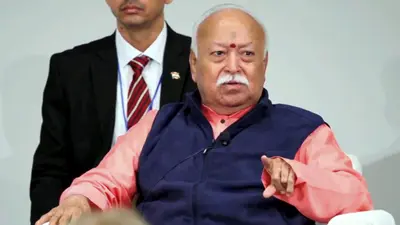
New York: Rashtriya Swayamsevak Sangh (RSS) chief Mohan Bhagwat on Saturday (August 29, 2026) said that his understanding of Hindutva does not envisage an India without Muslims, arguing that a person who believes Muslims should have no place in the country would cease to be a Hindu.
Bhagwat made the remarks while addressing an event in New York City, where he interacted with leaders from different communities and religions. His comments came while discussing questions raised by Muslims about the RSS vision of a Hindu Rashtra and what such an idea would mean for the country Muslim population.
According to Bhagwat, some Muslims had asked him whether the concept of a Hindu Rashtra meant that Muslims would eventually be driven out of India.
Responding to the question, he said that this was not what Hindutva meant. Bhagwat argued that Hindutva could not be understood as an idea that excluded Muslims from the country.
“I said, no, that is not Hindutva. If any Hindu thinks that there should be no Muslims in Bharat, he will not remain Hindu,” Bhagwat said.
Bhagwat Emphasises Inclusion
The RSS chief remarks place religious coexistence at the centre of his explanation of Hindutva. Rather than presenting the idea of a Hindu Rashtra as requiring the removal or exclusion of Muslims, Bhagwat said that Muslims have a place in the country.
His comments also appeared aimed at addressing concerns among minority communities about the ideological meaning of the RSS vision for India.
The statement is significant because debates around Hindutva, Hindu Rashtra, secularism and minority rights have remained deeply contested in India's political and social discourse.
A Wider Debate Over Hindu Rashtra
The idea of a Hindu Rashtra has generated different interpretations among political groups, academics and civil society organisations. Supporters have offered varying definitions of what such a framework would mean, while critics have raised concerns about its implications for India's constitutional commitment to equality and religious freedom.
Against this backdrop, Bhagwat's New York remarks offer his own interpretation- that Hindu identity and Hindutva cannot be reconciled with the belief that Muslims have no place in India.
The comments are likely to add another dimension to the continuing debate over how India's religious diversity should be understood alongside competing ideas of national and cultural identity.
Ultimately, Bhagwat message was that India's Muslim population cannot simply be excluded from his conception of the country or of Hindutva. The statement therefore shifts the focus from questions of religious majority and minority status to the broader issue of coexistence in a diverse society.
Attribution: Editorial
Examine Raw Source