
Politics
Indian Edition
Diplomacy Amid the Drama, Iran President Meets Abu Dhabi Crown Prince as West Asia Burns
The meeting signals that diplomatic channels remain open despite intensifying tensions and military confrontations across West Asia. However, the engagement alone does not indicate a break through,…
CMS Admin
Editorial · Honestly Biased
AI Narrative Bias Audit
The framing highlights the contrast between escalating regional hostilities and diplomatic engagement, while potentially simplifying the complex political motives behind the meeting
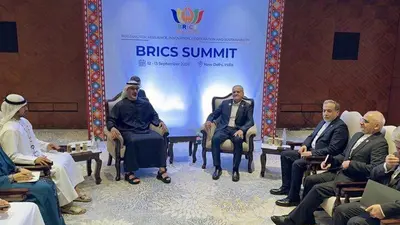
Against the backdrop of escalating hostilities in West Asia, Iranian President Masoud Pezeshkian and Abu Dhabi Crown Prince Khaled bin Mohamed bin Zayed Al Nahyan held talks in New Delhi on Saturday, September 12, on the side lines of the 18th BRICS Summit.
The meeting brought together two sides at a particularly sensitive moment, with regional tensions continuing to test diplomatic relations. The discussions focused on the ongoing hostilities in West Asia, with both sides expressing support for de-escalation.
The diplomatic encounter comes just ten days after Iran targeted military installations in the United Arab Emirates (UAE), adding another layer of significance to the New Delhi meeting. While the talks do not necessarily signal a major shift in relations, the willingness to engage directly highlights the importance of keeping diplomatic channels open during a period of heightened tensions.
The timing of the meeting also places India and the BRICS summit at the centre of an important regional diplomatic moment. With several conflicts continuing across West Asia, New Delhi has sought to position itself as a platform for dialogue while maintaining relations with different stake holder.
The New Delhi Declaration, adopted at the BRICS Summit and announced by Prime Minister Narendra Modi, expressed deep concern over the multiple conflicts in West Asia. However, the declaration stopped short of directly naming major stake holders, including the United States, reflecting the diplomatic balancing act surrounding the issue.
For Iran and the UAE, the meeting offered an opportunity to discuss tensions face to face rather than allowing military confrontation to completely define the relationship. Whether that diplomatic opening can translate into sustained de-escalation, however, will depend on developments beyond the summit room.
For now, West Asia appears to be sending two messages at once, the hostilities continue, but diplomacy has not left the table.
Distribute This Chronicle
Independent commentary breaks corporate silence when readers circulate the ledger directly to their peers.
Attribution: Editorial
Examine Raw Source