
Politics
UK Edition
Dover Disrupted as Stop the Boats Protest Makes Waves on Land
The report highlights the disruption caused by the Stop the Boats protest at Dover Port, portraying the demonstration primarily through its impact on travel and port operations. However, it give…
CMS Admin
Editorial · Honestly Biased
AI Narrative Bias Audit
The narrative focuse on the protest disruption to Dover Port, implicitly framing the demonstration as counter productive while providing limited context about the protester motivation or the wider debate over small boat crossing.
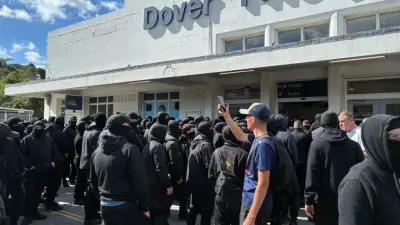
Dover- A large demonstration by masked protesters caused significant disruption around the Port of Dover, with roads blocked and traffic temporarily prevented from entering or leaving the busy ferry terminal.
Hundreds of demonstrators, many dressed in black and wearing face coverings, gathered in the area and were heard chanting stop the boats, referring to the ongoing political debate over people crossing the English Channel in small boats.
The protest began at around 07:00 BST, according to Dover and Deal MP Mike Tapp, and resulted in substantial disruption for local residents, ferry passengers and people travelling through the port.
Traffic brought to a standstill
The demonstration affected roads around the port, leaving vehicles unable to move in and out of the area.
One ferry passenger, Remco van Schellen, said he arrived from the Netherlands at around 08:00 and found that he could not continue his journey after leaving the ferry terminal.
He described seeing people dressed in black with their faces covered while roads and a roundabout outside the terminal were blocked.
London tour guide Rafael Pittman also described the situation as absolute chaos, saying he spent around three hours waiting to collect a group of tourists who had arrived at Dover.
The disruption highlighted how demonstrations at major transport hubs can quickly affect not only those taking part but also passengers, businesses and local communities.
Police move protesters from port
Kent Police described the gathering as a spontaneous protest and said officers moved the crowd away from the port towards Dover Priory railway station at approximately 11:30 BST.
The force said the demonstrators had dispersed by around noon.
No arrests were made, according to police.
Kent Police had not confirmed who organised the demonstration at the time of the report.
Questions over who organised the protest
Reform UK councillor for Dover West Paul King said he had been told the demonstration was a stop the boats protest.
Meanwhile, anti-hate organisation Hope Not Hate claimed that the Patriot Platform network had organised the event. The organisation said the network began meeting in July and had brought together members of anti migrant group from across the country.
Those claims had not been confirmed by Kent Police in the information available.
Far right activist Tommy Robinson and Danny Thomas also posted about the demonstration on X, praising those involved. Thomas has been described as the founder of the Patriot Platform network.
The involvement or support of individual and groups does not, by itself, establish that every person attending the demonstration belonged to the same organisation.
Protesters focus on small boat crossing
Demonstrators approached by the BBC generally declined to speak to the media. One person was heard saying send them back, while another repeated the stop the boats slogan.
The protest comes amid continued political debate in the UK over irregular migration across the English Channel.
Dover and Deal MP Mike Tapp criticised the demonstration, describing those responsible as people who had travelled to the area specifically to cause disruption.
He also pointed to a reported decline in small boat crossing, arguing that protesters should recognise efforts being made to address the issue.
Port operations return to normal
The Port of Dover later confirmed that operations had returned to normal and that routes into and out of the town had reopened.
The port thanked passengers and the local community for their patience while police dealt with what it described as a public-order incident.
Ferry operators also took steps to assist passengers affected by the disruption. P&O and DFDS said passengers who missed their scheduled crossings would be accommodated on the next available sailing.
A protest with consequences beyond its message
The demonstration brought attention to the political issue protesters wanted to highlight, but it also created immediate consequences for people who were simply trying to travel.
For ferry passengers, tourists and local residents, the morning was defined less by political slogans and more by blocked roads, delayed journeys and uncertainty over when normal movement would resume.
The incident also illustrates the tension surrounding protests at strategically important locations such as Dover. Demonstrators have a right to express political views, but when roads and transport infrastructure are blocked, the effects can extend well beyond the protest itself.
By midday, the crowd had dispersed and the main routes had reopened. For Dover, however, the morning's disruption served as another reminder that the country's heated migration debate can have very tangible consequences on the ground.
Distribute This Chronicle
Independent commentary breaks corporate silence when readers circulate the ledger directly to their peers.
Attribution: Editorial
Examine Raw Source