
Politics
Indian Edition
GDP Figures Under Question, Political Labels Fly, BJP Hits Congress
The BJP characterization of Congress GDP criticism as a dimagi Naxal mindset shifts attention from the substance of the economic data debate toward political labeling. A balanced assessment should…
CMS Admin
Editorial · Honestly Biased
AI Narrative Bias Audit
The framing amplifies the BJP, dimagi Naxal characterization while reducing Congress GDP related criticism to a partisan mindset, potentially steering readers away from evaluating the underlying economic data dispute.
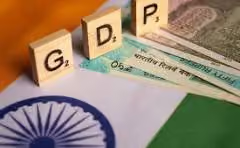
India latest GDP figures have triggered a fresh political dispute, with the Bharatiya Janata Party (BJP) accusing the Congress of using faulty calculations to question the government’s economic growth narrative.
On Thursday, September 3, 2026, the BJP alleged that Congress had manipulated the figure to turn India reported 7.8% real GDP growth into an imaginary 2.6%, and described the approach as reflecting a “dimagi Naxal” mindset.
The BJP response came after Congress general secretary (communications) Jairam Ramesh raised questions about revisions to India’s GDP estimates. Rather than simply disputing the headline growth figure, Ramesh questioned why GDP estimates for all four years since 2022-23 had reportedly been revised substantially downward and sought greater clarity about the changes.
He also questioned which components of the revised methodology had produced the revision, who had been consulted while developing the methodology, and whether the GDP deflator adequately captured the effect of inflation when calculating real GDP.
At the heart of the argument, therefore, is a technical question that has been overshadowed by political rhetoric- how should India economic growth be measured, and how should revised estimates be interpreted?
The distinction between nominal and real GDP is particularly important. Real GDP attempts to measure changes in the volume of economic activity after accounting for price changes, while the deflator is one of the tools used to convert nominal economic values into real terms. Changes in methodology, base years, datasets or deflators can consequently affect historical estimates without necessarily meaning that the underlying economic activity itself suddenly changed.
The BJP criticism focuses on what it considers an improper calculation by the Congress, while Congress is demanding transparency about the methodology and the reasons behind revisions to earlier estimates. Neither political characterization, by itself, settles the technical dispute.
The controversy also illustrates a recurring problem in economic debates- a complicated statistical disagreement can quickly become a political fight over headlines and labels. Describing an opponent’s interpretation as imaginary or attaching ideological labels to it may generate political attention, but it does little to explain why particular numbers changed or which calculation is statistically sound.
A more useful public debate would therefore put the underlying data first. The government statistical methodology, the assumptions behind the GDP deflator, the revisions to previous years and the calculations used by the opposition should all be examined independently.
Ultimately, the question is not simply whether India grew by 7.8% or whether an alternative calculation produces a much lower number. The more important question is which methodology correctly represents economic activity and whether that methodology is transparent enough for the public to scrutinise it.
Attribution: Editorial
Examine Raw Source