
Politics
Indian Edition
Maritime Mishap Meets 1991 Rulebook, Pakistani Ship Collides With Indian Vessel
The collision between a Pakistani ship and an Indian vessel has brought renewed attention to the 1991 maritime agreement and the rules governing such incidents. Whether the collision actually…
CMS Admin
Editorial · Honestly Biased
AI Narrative Bias Audit
The headline frames the incident primarily as a Pakistani treaty violation, which may imply legal culpability before the fact and applicable provisions of the 1991 treaty are independently established.
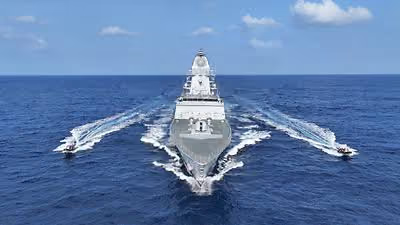
India has summoned Pakistan Charge d'Affaires in New Delhi over what it described as unacceptable and unprofessional conduct after a Pakistani naval ship collided with an Indian Navy vessel in international waters on September 15.
According to India Ministry of External Affairs, Pakistan Naval Ship (PNS) Hunain approached an Indian naval warship at high speed and manoeuvred in an unsafe manner, resulting in a minor collision. India said the incident was in direct contravention of Article 10 of the 1991 Agreement between India and Pakistan on Advance Notice on Military Exercise, Manoeuvres and Troops Movements.
What happened at sea?
The incident reportedly took place around 120 nautical miles from the Gulf of Oman, well beyond the 12 nautical mile limit generally associated with a country territorial sea under the UN Convention on the Law of the Sea.
The Indian Navy vessel was carrying out a routine surveillance mission in the North Arabian Sea when PNS Hunain approached it, according to the Indian government account.
India said the Pakistani vessel was moving at high speed and manoeuvring unsafely before the two ships collided. PNS Hunain sustained damage, while no damage was reported to the Indian vessel, which continued its mission.
The incident has also revived memories of a previous encounter between Indian and Pakistani naval vessels. On June 16, 2011, Pakistani naval warship PNS Babur brushed past the Indian Navy frigate INS Godavari in the Gulf of Aden, reportedly causing minor damage to the Indian vessel’s helicopter safety net.
What does the 1991 agreement say?
The 1991 Agreement between India and Pakistan on Advance Notice on Military Exercises, Manoeuvre and Troops Movements was designed to reduce the possibility of military misunderstanding between the two countries.
The agreement established a mechanism under which India and Pakistan would inform each other about certain military exercises and troop movements. Its stated objective was to prevent a crisis arising from a misreading of the other side intentions.
The pact covers the land, naval and air forces of both countries. It also establishes restrictions and notification requirements for major military activities conducted close to the other country territory.
For naval forces, the agreement defines a major exercise as one involving six or more ships of destroyer/frigate size and above operating together and crossing into the other country’s Exclusive Economic Zone (EEZ).
Why is Article 10 important?
The provision at the centre of the latest dispute is Article 10, which deals specifically with the distance naval vessels and submarines should maintain from each other while operating in international water.
The article states that naval ships and submarines belonging to the two countries should not close to less than three nautical miles from each other, with the aim of avoiding accidents.
India has said the September 15 collision amounted to a violation of this provision.
The significance of the provision is straightforward, even when Indian and Pakistani naval vessels are operating outside territorial waters, the agreement establishes a minimum separation intended to reduce the risk of accidental or dangerous encounter.
International waters do not mean anything goes
The collision occurred in international waters, but that does not necessarily mean naval vessel operate without rules.
Under the law of the sea, territorial seas generally extend up to 12 nautical miles from a state coast, while an EEZ can extend up to 200 nautical miles. An EEZ gives a coastal state specific rights over resources and certain economic activities, but it is not the same as territorial water.
The 1991 India, Pakistan agreement adds another layer of rules specifically governing the interaction of the two countries military forces.
That distinction matters in this case, the location of the incident and the question of whether Article 10 was breached are separate issues from whether the ships were operating inside territorial waters.
A maritime collision with diplomatic consequences
What began as a physical encounter between two naval vessels has therefore developed into a diplomatic issue between India and Pakistan.
India's decision to summon Pakistan Charge d’Affaires signals that New Delhi considers the conduct serious enough to raise through diplomatic channels. Pakistan position and any further official account would be relevant to assessing the circumstances surrounding the collision.
For now, India stated position is that PNS Hunain violated the three nautical mile separation requirement contained in Article 10 of the 1991 agreement. The incident has once again placed a decades old confidence building arrangement between the two nuclear armed neighbours under scrutiny.
Distribute This Chronicle
Independent commentary breaks corporate silence when readers circulate the ledger directly to their peers.
Attribution: Editorial
Examine Raw Source