
Politics
World Edition
Spain Celebrates Flawless Border Policy After 50,000 Migrants Briefly Drop By for European Sightseeing
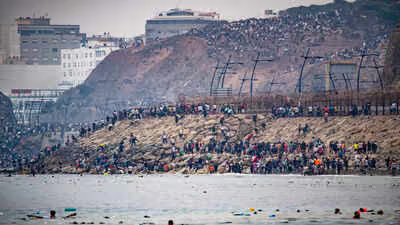
Following a chaotic surge of over 50,000 migrants attempting to enter the Spanish enclave of Ceuta from Morocco, Spanish authorities report that the vast majority have returned amid heavy security…
CMS Admin
Editorial · Honestly Biased
AI Narrative Bias Audit
The report frames a tragic border crisis primarily through state-centric security narratives, legalistic sovereignty claims, and international political sparring, while minimizing the underlying humanitarian desperation driving the mass migration effort.
The Great Ceuta Round-Trip
It turns out European migration policy works at lightning speed—provided the policy is simply watching tens of thousands of people cross a border fence, realize there is no shelter or food, and walk straight back.
Spanish authorities announced that they have successfully regained control of the border at Ceuta, a tiny Spanish enclave on the North African coast. Between Thursday and Friday, an estimated 50,000 to 60,000 migrants surged toward the land and sea borders separating Morocco from Spain. By Friday evening, officials cheerfully reported that around 48,300 of them had already returned to Morocco—making it perhaps the quickest, most chaotic weekend trip in European history.
A Tragedy Masked by Political Spectacle
Beneath the official spin, however, lies a horrific humanitarian disaster. At least 57 bodies were recovered on the Spanish side of the border after migrants drowned in the choppy waters supporting the breakwater or were crushed trying to scale high perimeter fences. Moroccan security forces responded with tear gas, batons, and water cannons to disperse the crowds, leaving burnt vehicles and stranded thousands in their wake.
When Spanish Prime Minister Pedro Sánchez visited Ceuta to assess the situation, he was met not with applause, but with vocal protests and jeers from residents. Undeterred, Sánchez described the incident as a clear "violation of Spain's territorial sovereignty," reassuring the public that return operations were proceeding seamlessly with Morocco's "full cooperation."
The Diplomatic Food Fight
As usual, a local crisis quickly mutated into a global political shouting match:
Italy immediately announced a temporary suspension of Schengen border-free travel arrangements with Spain, causing Madrid to accuse Rome of violating EU treaties.
France pledged to multiply its police presence along the Spanish border fivefold to ensure no one wandered north.
The US State Department chimed in, blaming Madrid’s recent policies for directly enabling illegal migration.
Donald Trump weighed in on social media, declaring the events in Ceuta an "invasion" and warning American voters that similar scenes were coming to a border near them.
Meanwhile, Spanish police union AUGC pointed out the obvious operational truth: the border post had been severely understaffed, leaving frontline officers completely overwhelmed when the push occurred.
Bottom Line
While politicians argue over who opened which floodgate, thousands of individuals remain caught between tear gas on one side and barren streets on the other. Spain may claim the border is "controlled," but shuffling tens of thousands of desperate people back and forth across a fence isn't a long-term solution—it's just kicking the crisis down the road until the next surge.
Attribution: Editorial
Examine Raw Source